

Kathryn Schulz is a staff writer at the New Yorker, whose Pulitzer Prize winning article about the Cascadia Subduction Zone put the fear in many of us living in the Pacific Northwest. I could not go back to my previous complacency until I put together earthquake emergency kits for my car, my fiancée’s car, and my mom’s truck.
In another great New Yorker article, Schulz marvels philosophically at the human mind’s capacity to “reason about unreasonable things,” like calculating the wingspan necessary for a dragon to fly and deciding that a yeti is more possible than a leprechaun.
Her article, “Fantastic Beasts and How to Rank Them,” presented the reader with a parlor game in which you are supposed to rank all manner of mythical or fantastical creatures with respect to their possibility of existing. Is a leprechaun less impossible than a zombie? Ask your friends, she says, and there will be “a surprising amount of concord” in their rankings. Nevertheless, it’s paradoxical, Schulz says, because possibility is either/or; it does not admit of degrees. “So, how, exactly, are we drawing these distinctions?” she asks.
Did no one at the New Yorker think to ask a philosopher about the logic of possibility and impossibility? Schulz’ framework—her discussion of possibility and impossibility—is at best misleadingly off kilter.
Schulz is talking about what philosophers call the logic of modality, or modal logic. In the 2500-year history of philosophy there has been a lasting preoccupation with possibility and necessity. Philosophers study those concepts in their own right, but they also employ possibility and necessity in the arguments they put forth.
St. Anselm argued that necessarily God exists. Descartes argued that it is logically possible for the mind to exist separately from the body. Berkeley held that it is impossible to be and to be unperceived. Descartes (him, again!) argued that knowledge consisted of propositions impossible to doubt.
Inductive arguments are for scientists; deductive arguments are what philosophers offer when defending their positions. Science is based on empirical experiments. It takes many particulars and arrives at a generalization, which, if good, will be said to be highly confirmed by the evidence.
An inductive argument works like this:
Premise 1) The first time I saw that dog it bit me.
Premise 2) The second time I saw that dog it bit me.
Premise 3) The third time I saw that dog it bit me.
Conclusion: Therefore, the next time I see that dog there is a high probability that it will bite me.
How about a sports analogy from the Pacific Northwest? When Damian Lilliard steps up to the free throw line, we know that the probability he will make the shot is 90%. How? Because, roughly speaking, we’ve seen him in the past take 1000 shots and he made 900 of them.
On the other hand, when a deductive argument is sound—when it has a valid logical structure and the premises are true—then the conclusion will not only be true, but it will be necessarily true, true by logical necessity.
Here is a classic example of a deductively valid argument form.
Premise 1) If P then Q.
Premise 2) P.
Conclusion: Therefore Q.
If we imagine premises 1 and 2 were true, then it will be impossible to deny the conclusion, i.e., the conclusion would be necessarily true. Try it. Imagine that “If P then Q” is true. Now imagine that “P” is true. You see the implication is the truth of “Q”. Indeed it is impossible to deny the truth of “Q” while imagining that “If P then Q” and “P” are true. That shows you it is valid.
Imagine a philosopher argues that “If an entity is conscious, then it deserves moral consideration” and “C-3PO is conscious.” If those two premises can be shown (or imagined) to be true, then the proposition “C-3PO deserves moral consideration” would be as equally logically guaranteed as “all triangles have three sides.”
“Impossible to deny the truth” means “impossible to be false” which means “necessarily true” which means “proven.” If someone says, “You don’t know Lilliard will make the shot because you haven’t proved he’ll make the shot,” then they are making the mistake of bringing in the concept of proof where only degree of empirical confirmation is appropriate.
Possible, impossible, necessary: To get a flavor of how these concepts work, let’s take the square circle. We feel intuitively that the square circle is perhaps a kind of paradox, but what’s going on is a square circle is logically impossible. It’s logically impossible because it contains a contradiction in terms; it’s conceptually self-contradictory. Something is logically impossible if it is inconceivable in virtue of containing a logical contradiction in the terms or concepts making up its definition or description.
Impossibility and necessity are inter-defined as follows: Something is necessarily true if it is impossible that it be false. Or P is necessary if it is not possible that not P.
If you’re lost, don’t worry. Some of these concepts lend themselves to everyone’s favorite technical drawing: the Venn diagram.
Draw an oval. Put one dot or rectangle near the center. That one rectangle is how things actually are. The area—the square footage, so to speak—inside the oval represents all the great variety of ways things could be in terms of logical possibility. The dot includes my salt-and-pepper hair; the area outside the dot but within the oval represents me with blond hair, and me with black hair, and me with white hair, and me with blue hair—all possible hair colors.
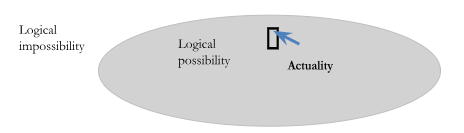
The area in the oval includes any situation, state of affairs, fact (or related proposition) that sheer logic leaves open (i.e., that sheer logic does not exclude as impossible). Outside the oval is the realm of propositions that logic excludes from being possible. Out there in the realm of logical impossibility is where the square circle lives, along with “four-sided triangle,” “virgin mother,” “married bachelor,” “compassionate conservative” and other oxymorons.
Some epistemologists and philosophers of science would add another oval to our Venn diagram in order to represent what is possible, impossible, and necessary according to the laws of nature. Make another oval around the rectangle of actuality but all within the oval representing the limit of logical possibility. Within this smaller oval now is included situations which are logically possible and also physically or naturally possible. Outside this new oval are situations that are still logically possible but which are ruled out by the laws of nature.
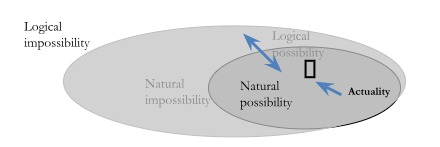
But, it must be said, that is only one school of thought among others in the philosophy of science. Another school of thought, David Hume’s way of thinking about possibility and necessity, denies the existence of natural necessity entirely. Followers of Hume would say that we ought to do without the second oval you just drew. Anything that is logically possible is naturally possible; it might have seemed impossible by the laws of nature, but really it is just highly improbable.
David Hume—the Scottish philosopher and perhaps the biggest name between Descartes and Kant—said that, for all we can rationally know, even those states of affairs excluded by the laws of nature are not necessarily false. Hume is famous for having said it was not logically impossible that the sun will fail to rise tomorrow. That’s a lot of double negatives. Let’s clean it up. What Hume was saying is that it’s a possibility that tomorrow the sun will not rise. It’s a possibility, also, that you could jump out the window right now and you would not accelerate toward the ground, increasing your velocity by 9.8 meters per second every subsequent second. The point is, we are talking about the laws of nature and it remains possible that the laws themselves will change tomorrow.
It’s a possibility, a logical possibility. “But, so what?” I can hear Hume saying. It is very improbable in terms of natural probability. That you won’t fall is empirically very unlikely.
To be fair, Humean metaphysics is surprising and strange. What sounds odd is saying that something that we pretty much know isn’t going to happen has a slight chance of happening. And it also sounds strange to say that something we know to be true as well as we know anything, like the sun rises in the East, might no longer be true tomorrow. However, it is essentially an implication of what we say about scientific knowledge when we are thinking clearly about how science works.
“Isn’t the regularity of the sun rising in the East naturally necessary?” I hear you asking. “Don’t the laws of nature make it necessary that I will fall?”
No, it’s not logically necessary and it’s not naturally necessary either. Because there is no such thing as natural necessity, at least according to Humean philosophy of science.
According to Hume, the only necessity to be found in the universe is the “necessity” we put there. It is really just our expectations, which we have arrived at via an inductive process. The only necessity anywhere is in the necessarily true truths of mathematics and of logic or in propositions true by definition. Logical necessity can be found in the logical implications of internal inferences in our conceptual scheme, but not in nature.
Why? Because, for Hume, laws of nature are generalizations with the weight behind them only of inferences of an inductive kind and inductive inferences are always less than 100% certain. If we take a law of nature like Newton’s second law, f=ma—force equals mass times acceleration—then a Humean says that f=ma is true but not necessarily true. A Humean says it is not impossible that “f” not equal “ma,” which is equivalent to saying it is possible that “f” not equal “ma.” It is possible, just highly improbable… because every time we’ve measured “f” it has indeed equaled “m” times “a.” Do we know it will tomorrow? Yes, we know it will with as much certainty as can be had inductively. But we do not know it as a matter of logical necessity.
However, don’t jump out the window please Reader—the author and publisher hereby disavow any perceived instruction that the reader should jump out the window and we cannot be held legally liable—because we know you will fall as well as we know anything. We just don’t know it the way Descartes thought was necessary to count as knowledge. [Note: I discuss Descartes’ epistemology in greater detail in an earlier post to Substack, here.]
But Descartes’ definition of what should count as knowledge, while intuitive in some respects, in the end does not work and must be rejected. It doesn’t work to say that knowledge is only achieved by propositions that are impossible to doubt, i.e., necessary. It works for math but not for the physical world. Impossibility is binary, without shades of gray, without degrees. But we need degrees of knowing.
Descartes has no way to say I know X with a higher probability than I know Y. But, in real life, knowledge must be able to countenance probabilities and degrees of confirmation.
Of Schulz’s examples of fantastic beasts, take the unicorn. A unicorn is not logically impossible; it is logically possible. We know it is logically possible precisely because we can conceive it. There is no logical contradiction inherent in it that would prevent us from conceiving it, whereas there is exactly such in a square circle. What keeps a unicorn from existing is not logic but nature. And not nature as it necessarily is, but nature as it just happens to contingently be. A unicorn could exist according to the laws of nature; it is simply that it happens not to.
A unicorn is like a golden mountain. A mountain made of gold is not impossible, neither logically nor naturally. There is no logical contradiction in conceiving of it and no law of nature would be broken if it did actually exist.
A golden mountain is just very unlikely or improbable (but, again, not impossible). Given enough time and resources we could build one; or, if in infinite time every possibility eventually happens, then the universe could accidently make a golden mountain. It is just highly improbable.
Why we are able to rank the intuitive degree of “likelihood of existing” with respect to what Schulz says are “impossible creatures” is because they are not impossible; they have varying degrees of improbability.
Why should we talk about it like I recommend and not like Schulz does? Why think that fantastic beasts are not impossible but only improbable? You already talk in the way I recommend when you say this or that bit of scientific knowledge is 99.9999% confirmed. Scientists talk my way when they refuse to say a theory has been “proved.” Science never gets to “necessarily so” and it’s a mistake to want it to.
The notion of degree slips in there because we should be talking about probability, not possibility. In fact, we are thinking in terms of probability, but Schulz just incorrectly labels it impossibility.
And, furthermore, Schulz is actually doing one of the kinds of things Hume is famous for. He said that it is possible that the sun will not rise tomorrow. He said that if you jump out the window you will not necessarily fall. Hume was talking about—in his terminology—situations or things that seemed impossible but were actually best thought about as possible just highly improbable. Schulz, for her part, was thinking about fantastic, seemingly impossible beasts in terms of their relative probability and improbability, and calling them impossible when really they’re possible just improbable.
I hear my reader asking, “What if I could argue that a unicorn was less like a golden mountain and more like an uranium mountain?” An uranium mountain—one might intuitively think—is forbidden (made impossible) by the laws of nature since at a certain critical mass uranium suffers enough gravitational force from its own mass to undergo nuclear fusion: it explodes well before it becomes a mountain. So, it is naturally impossible, even if logically possible, unlike the golden mountain, which is logically possible and also naturally possible.
Here’s my Humean answer to that. The laws of nature which govern the critical mass required for nuclear fusion of uranium, are just like f=ma as far as Humean philosophy of science is concerned. Force equals mass times acceleration is only true with a less-than-100% percent probability because no knowledge gathered empirically is 100% certain. This does not mean we don’t know that f=ma. Instead it means that what we mean by “know” is different from what Descartes had suggested “know” meant.
A golden mountain is highly improbable, but an uranium mountain is even more improbable than a golden mountain. But both remain possible.
What would be required to make the improbable golden mountain actual is just a somewhat unlikely arrangement of matter. But what would be required to make a uranium mountain would the highly unlikely (yet logically possible) violation of the laws of nature.
The alternative is to seek and never find necessary truths—to seek and never find, in our empirical investigations of the physical world, truths impossible to conceive otherwise, truths impossible to doubt.
I like Hume’s ideas better overall. You?
The vibrant zombie leprechaun community cannot be silenced.
My concern is not the Humean definition, but those who use the smallest sliver of doubt as an excuse to ignore cold, hard facts — even when, as Scotty from Star Trek would put it, you "can't change the laws of physics." Look no further than America’s relative inaction on climate change. By accepting Hume’s premise, we give people permission to hide behind a 0.00001% margin of uncertainty, despite knowing beyond reasonable doubt that human activity drives global warming.