
Anything’s Possible: Cartesian Epistemology Is Behind Conspiracy Thinking.

Several years have now elapsed since I first became aware that I had accepted, even from my youth, many false opinions for true, and that consequently what I afterward based on such principles was highly doubtful; and from that time I was convinced of the necessity of undertaking once in my life to rid myself of all the opinions I had adopted, and of commencing anew the work of building from the foundation, if I desired to establish a firm and abiding superstructure in the sciences.
— René Descartes, Meditations on First Philosophy, 1640 A.D., trans. John Veitch
One day during the era of COVID-19 and Trump 1.0, my then-girlfriend, Kelly, and I hiked the Neahkahnie Mountain trail on the Oregon coast. We needed a break from the incessant news cycle, and from the misinformation and conspiracy theories on social media. A growing segment of Americans seemed capable of believing unbelievable things. That segment included Kelly’s father.
She and I had recently watched Kate Snow of NBC file a report on the Q-Anon conspiracy theory: “Chloe Neely is a mom of two who spends Sundays on the soccer sidelines. She subscribes to some of Q’s more outlandish unproven theories,” said Snow. Talking with Neely, Snow asked, “Do you believe that there is a satanic […] group of people [including Democrats and celebrities] who are trafficking children and drinking their blood?”
“I would like not to believe that,” Neely said, attempting a laugh.
“But you think it might be… or is?”
“Yeah, I think it definitely could be possible, yes.”
“God help us,” opined Brian Williams.
“Piss poor epistemology!” said Kelly.
“Oh,” I said, “I’m gonna use that.”
As a philosophy professor, I occasionally teach critical thinking classes and I had been looking for a catchall term for a list I’m keeping of epistemic errors people regularly make on TV.
But just then we arrived at the sea cliff overlooking Treasure Cove, and north beyond it, Smuggler’s Cove. My mind cleared. Flowers and meadow grasses covered the ground all the way to the edge of the cliff. It was a vertiginous drop, five-hundred feet straight down. I thought to myself: Didn’t the edge used to be farther out? I realized a part of the cliff face must have recently broken off and fallen into the ocean. Suddenly I got dizzy. My heart raced and I started sweating. I felt like I was going to pitch over the edge. I dropped to my hands and knees.
The world whirled around me—around me whirled the world.
I forced myself to crawl to the edge next to Kelly, who might as well have been standing in Amy Cuddy’s Wonder Woman pose. She does not share my fear of heights.
“You all right?” she asked.
“Yeah—head just got a bit wooly.”
I decided I would stand up. But I was going to take it slow. First, I crawled away from the edge, then I got up on one knee and untied and re-tied my bootlaces in preparation for, and to delay, finally standing up. I could sense Kelly was watching me.
“Hey,” she said after I finished, “You are tying your shoes with a granny knot.”
“Really?”
I undid them and tied them again, at first for myself but then sheepishly so she could see.
“Yep. That’s a granny knot,” she said.
Evidently, I’ve been tying my shoes wrong my whole life. No wonder I’ve always needed to double knot them! If I could be wrong about this, I could be wrong about anything. Jesus, what else had I been wrong about my entire life? Watching the foundational supports of my own epistemological surety tremble was frankly as vertiginous a feeling as looking down over the edge of the sea cliff. I got dizzy all over again.
The world whirled around me—around me whirled the world.
The American tree sparrow and the chipping sparrow look remarkably similar. Both have a cinnamon or rust colored cap and both have two white bars of the same width on their wings. Finally, both have a grey breast. Only the American tree sparrow has a breast spot of white. To tell the birds apart, the white spot is dispositive since the chipping sparrow lacks one.
Imagine: I was out birding with a friend in Montana, the territorial home of these two kinds of birds. My friend claimed to know he saw an American tree sparrow without determining if it had the white breast spot or not. What would we say in a case like that? I think my friend’s lack of epistemological scruple would weird us out. You can’t say you know it’s an American tree sparrow unless you’ve eliminated the possibility that it might be a chipping sparrow. That’s part of what the word “know” means.
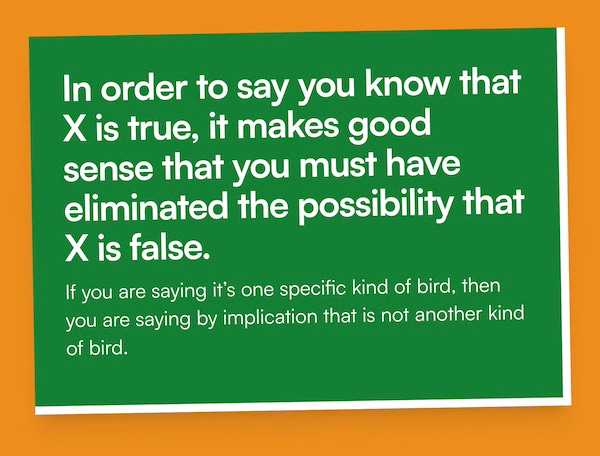
Descartes’ definition of knowledge built on this point. Forgive me a brief dalliance with some slightly more philosophical verbiage, including a sparse use of variables, so I can explain Descartes’ epistemology, his definition of knowledge. In order to say you know that X is true, it makes good sense that you must have eliminated the possibility that X is false. If you are saying it’s one specific kind of bird, then you are saying by implication that is not another kind of bird.
If it were the wrong kind of bird, that would “defeat” your initial claim. Descartes generalizes this sensible requirement of eliminating defeating possibilities. According to Descartes, in order to know X, you must eliminate any defeating possibilities, which we can label collectively “P.” In other words, to really know X, your evidence for X must eliminate P, where P is all the possibilities in which X is false.
You gotta make sure it’s not a chipping sparrow if you’re saying it’s an American tree sparrow. But you also have to make sure it’s not a taxidermied American tree sparrow, nor an audio-animatronic American tree sparrow escaped from Disneyland, nor just a dream of an American tree sparrow, nor an American tree sparrow consisting of 1s and 0s in the Matrix. Because if it’s any of those, it’s not what you claimed to know it was.
Requiring knowledge to be beyond all possible doubt has a lot of our commonsense intuitions in its favor. When my birding friend uses the word “know” in a way that deviates from Descartes’ definition of knowledge, we feel my friend is wrong or crazy. That is good support for Descartes’ theory. It’s intuitive, at least that far. It captures a lot of what we mean by “know.”
However, Cartesian epistemology has a fatal flaw.
When the film The Matrix came out, a few philosophers got paid Hollywood money to pen essays about the philosophical bona fides of the film.
“Have you ever had a dream, Neo, that you were so sure was real?” Laurence Fishburn’s Morpheus says to Keanu Reeves’ Neo. “What if you were unable to wake from that dream? How would you know the difference between the dream world and the real world?”
The idea that we might right now all just be dreaming is a Cartesian idea. Descartes realized that if he had ever had a dream that seemed real, then how could he tell that right now—which seemed real—was not a dream? Answer: He couldn’t.
If it seems to me that I am sitting by the fireplace in my dressing gown holding a piece of paper, Descartes wrote, and yet I am actually only dreaming that I am sitting by the fireplace in my dressing gown holding a piece of paper, then it follows that I am not actually sitting by the fire and the rest because instead I am lying prone in bed, asleep.
The fact that we might be dreaming was a defeating possibility that could not be eliminated. The skeptical argument in Descartes is (1) To know X you must know you’re not dreaming; and (2) You can’t know you aren’t dreaming. Together, (1) and (2) imply we never know anything, never actually have genuine knowledge.
Except that you exist. The one thing we can know is the conclusion of the famous cogito ergo sum: “I think therefore I am.”
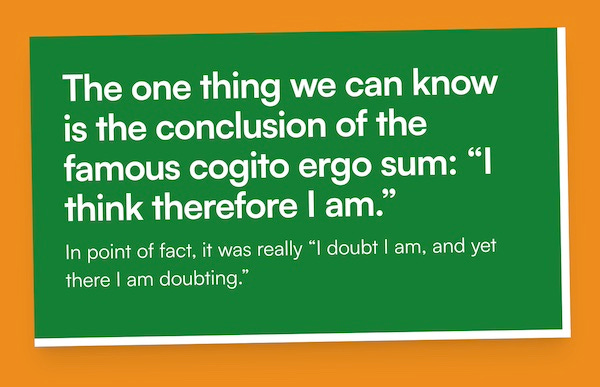
In point of fact, it was really “I doubt I am, and yet there I am doubting.” Or even: “I think I might be dreaming, yet there I am thinking.” So, the one thing that can be known beyond any possible doubt is that I am a thinking thing, a consciousness, a seat of experience—not a body, mind you, just a mind.
Descartes went on from there to build up a reconstruction of scientific knowledge from the foundation of the cogito, but hardly anyone accepts it. Instead, his legacy has been to be associated with an epistemological skepticism bordering on solipsism. Knowledge needs to be impossible to doubt, he said. However—except for the cogito—it never is.
In the 2500-year history of philosophy there has been a lasting preoccupation with possibility and necessity. Philosophers use these logical concepts as well as analyze them. St. Anselm argued that necessarily God exists. Descartes argued that it is logically possible for the mind to exist separately from the body. Berkeley held that it is impossible to be and to be unperceived. Descartes argued that knowledge consisted of propositions impossible to doubt.
The support for these philosophical positions were offered in the form of deductive arguments, which stands in contrast to modus operandi of science which works mostly by induction. Based on empirical experiment, science takes many particulars and arrives at a generalization, which, if good, will be said to be highly confirmed by the evidence.
An inductive argument works like this:
Premise 1) The first time I saw that dog it bit me.
Premise 2) The second time I saw that dog it bit me.
Premise 3) The third time I saw that dog it bit me.
Conclusion: Next time I see that dog there is a high probability it will bite me.
When Damian Lillard steps up to the free throw line, we know that the probability he will make the shot is 90%. How? Because, roughly speaking, we’ve seen him in the past take 1000 shots and he made 900 of them.
The laws of nature—such as Newton’s Second Law, f=ma, force equals mass times acceleration—are not said to be “proven,” only very highly confirmed, or 99.9999% certain.
On the other hand, the following is a classic example of a deductively valid argument form, which can give 100% certainty:
Premise 1) If P then Q.
Premise 2) P.
Conclusion: Therefore Q.
If we imagine premises 1 and 2 were true, then it will be impossible to deny the conclusion, the conclusion will be necessarily true. Try it. Imagine that “If P then Q” is true. Now imagine that “P” is true. You can see the implication is the truth of “Q”. Indeed, it is impossible (contradictory) to imagine denying the truth of “Q” while also imagining that “If P then Q” and “P” were true.
Let’s look at an example argument in that form: A philosopher might argue that “If an entity is conscious, then it deserves moral consideration” and “C-3PO is conscious.” If those two premises can be shown to be true, then the proposition “C-3PO deserves moral consideration” is as equally logically guaranteed as “all triangles have three sides.”
Do you balk at that, Reader? Are you offended by the assertion that something might be true necessarily?
The great Scottish philosopher David Hume made perhaps the most devastating critique of philosophers’ concept of necessity. Hume began his case by pointing out that for all we can rationally know, even those states of affairs excluded by the laws of nature are not necessarily false. Consider Hume’s famous example. Hume said it was not logically impossible that you could jump out the window and not fall to the ground. That’s a lot of double negatives. Let’s clean it up. What Hume was saying is that it’s a possibility that you jump out the window and float up and away, contrary to the laws of nature.
It’s a possibility, a logical possibility because, again, induction does not get you 100% certainty. “But,” as Hume would say, “So what?” What matters is that your floating away is very improbable in terms of natural probability. That you won’t fall is empirically very unlikely, and that’s what matters to knowing what will happen when you jump out the window.
Because, for Hume, the laws of nature are generalizations with the weight behind them only of inferences of an inductive kind, and inductive inferences are always less than 100% certain.
The only real necessity anywhere in the universe is in the necessarily true truths of mathematics and of logic, or in propositions true by definition, like “All bachelors are unmarried males,” and “all triangles have three sides.” Necessity can be found in the internal inferences within our conceptual scheme, but not in nature. Not since Hume.
Under a Humean meaning for the word “know,” do we know that you’d fall if you jumped out the window? Yes, actually. We know you will fall with as much certainty as can be had inductively. But we do not know it as a matter of logical necessity.
So, please don’t jump out the window, Reader—the author and publisher hereby disavow any such perceived instruction and cannot be held legally liable—because we know you will fall as well as we know anything. We just don’t know it the way Descartes thought was required to count as knowledge. But his definition of what should count as knowledge, while intuitive in some respects, in the end does not work and must be rejected. It doesn’t work to say that knowledge is only achieved by propositions that are impossible to doubt, i.e., necessary. It works for math, but not for the physical world. Impossibility is binary, without shades of gray, without degrees. But we need degrees of knowing.
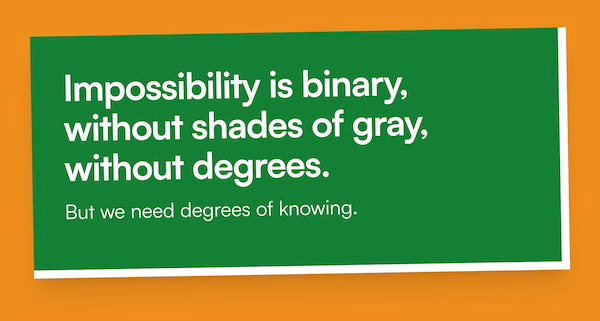
Descartes has no way to say I know X with a higher probability than I know Y. But, in real life, knowledge must be able to countenance probabilities and degrees of confirmation.
The Cartesian alternative to knowledge by degrees is to seek and never find necessary truths—to seek and never find, in our empirical investigations of the physical world, truths impossible to conceive otherwise, to seek and never find truths impossible to doubt.
With what we’ve got on the table now, I can explain what’s Cartesian about conspiracy thinking. The same explanation has the added value of explaining what’s wrong with some well-worn epistemological bromides: “We cannot predict the future,” “I can’t know another person’s mind,” “Absence of evidence is not evidence of absence,” and “You cannot prove a negative.” Those are all errors.
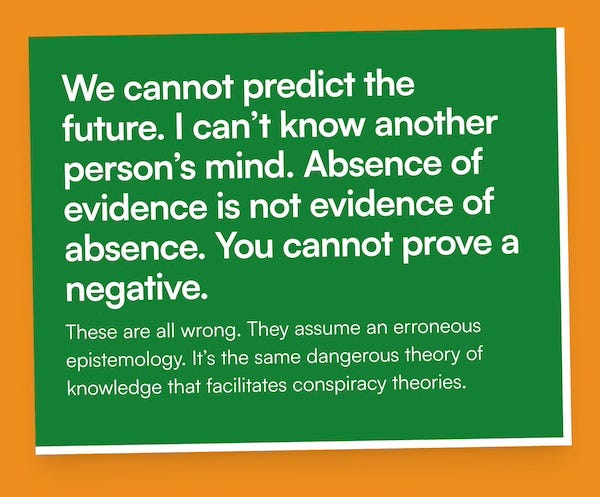
I’ll show how these are mistakes in thinking, and then I’ll correct them by using Hume’s definition of knowledge and eschewing Descartes’.
Incorrect cliché: We cannot predict the future
Humean truth: We predict the future all the time
We cannot be 100% certain about what will happen in the future, but we do in fact make predictions all the time that turn out to be true. And we can in fact get all the way up to 99.99999% probability in certain cases. Just let your prediction rely on a regularity you’ve observed in nature many times before. We predict the future a million times a day every time a piece of technology such as a watch or computer works as expected, since technology is based on our understanding and manipulation of the regularities known as the laws of nature.
Incorrect cliché: I cannot know another person’s mind
Humean truth: We can very well know another person’s mind
The impenetrability of another’s mind is given the lie a thousand times a day. Every gossip session, in which we explain a friend’s behavior by attributing a mental state to our friend, proves the point. We can in many contexts know another person’s mind as well as we know almost anything. Provided you know what “know” means.
Incorrect cliché: Absence of evidence is not evidence of absence
Humean truth: Yes, it is, if you’ve looked systematically and thoroughly for evidence
The absence of evidence for the Pastafarian’s god, the Flying Spaghetti Monster, is evidence of its absence. It’s not proof. It’s evidence.
The concept of proof is misplaced here. Proof belongs to contexts of logical argumentation and deductive inferences. Evidence and the degree of confirmation by evidence are the relevant concepts when we are talking about empirical reality.
Incorrect cliché: You cannot prove a negative
Humean truth: Proof is misplaced as an epistemic concept except in logical deduction
“You cannot prove a negative.” Fine. That’s true. But it’s worse than useless because, again, proof is the wrong standard. Instead, induction is king here. And what you are able to do with inductive inferences from more and more evidence is make a quote-unquote negative less and less probable until it is as improbable as anything we know does not and will not happen.
Much of American conspiracy theory thinking comes from some Americans’ inability to think probabilistically and statistically. They fail to think of knowledge as Hume recommends and persist in thinking like Descartes, whose epistemology focused too much on what’s logically possible and not enough on what is empirically probable.
What, after all, does the conspiracy theorist say? They say that their cherished, conspiratorial conclusion cannot be definitively disproven by their opponents.
“You can’t prove that what Q-anon says is false,” they say breathlessly.
“You can’t know for sure that Hillary Clinton didn’t run a child sex ring out of a pizzeria!”
Notice the structural similarity between those conspiracy-type thoughts and the Cartesian assertion: “You can’t prove for certain that we are not living in the matrix.” “You can’t prove that Democrats and celebrities are not drinking children’s blood.”
Unless everything is hopeless, I think it will help to avoid conspiracy thinking by recognizing that it partakes of a discredited and in any case unworkable epistemology by which only something impossible to doubt gets to be called knowledge.
Yet, you know what, I have still not bothered to learn how to tie my shoes properly.
Well, I did Google it and I found some instructions. But the habit of how my fingers throw the laces around is so deep in muscle memory I didn’t bother more than twice to try to change it. And I think I’m okay with that.
The new, occasionally dizzying question becomes: What else are we wrong about that we nevertheless won’t care to change our views on? And, when it’s important enough that refusing to change would count as a character flaw and moral failing, how will we know?
Nonsense. I think we’ll know. We’ll know at least to a moral certainty. We’ll know with probability sufficient to allow no reasonable doubt. And then we just have to be reasonable. Is that too much to hope for?

“Those who cannot understand how to put their thoughts on ice should not enter into the heat of debate.” —Nietzsche