


During the post-acceptance editorial process, the Associate Editor of the Missouri Review put a comment on my manuscript, highlighting my use of the word “voluntary.” “What sense,” she asked, “can ‘voluntary’ have in the context of free will denial?” This is a natural and reasonable question. However, “free will” is not defined as “voluntary action,” at least not in the debate as conducted by philosophy professors in America, Britain, and Australia.
Philosophers are convinced—the reasonableness of that question not withstanding—that if non-philosophers attempted to define free will they would eventually arrive where the professors have.1 Namely at two broad kinds of definitions of free will. The first is magical, the second is more down to earth. The first doesn’t really withstand philosophical scrutiny.2 The second can sound a tad finger-wagging as it lists out and systematizes all the responsibility-conferring character traits, desires, and intentions that seem intuitive when you hear them. The second—so-called “compatibilism”—is imminently reasonable. The problem is, lots of regular people—“the folk,” as philosophers call non-philosophers—believe in the first magical definition.
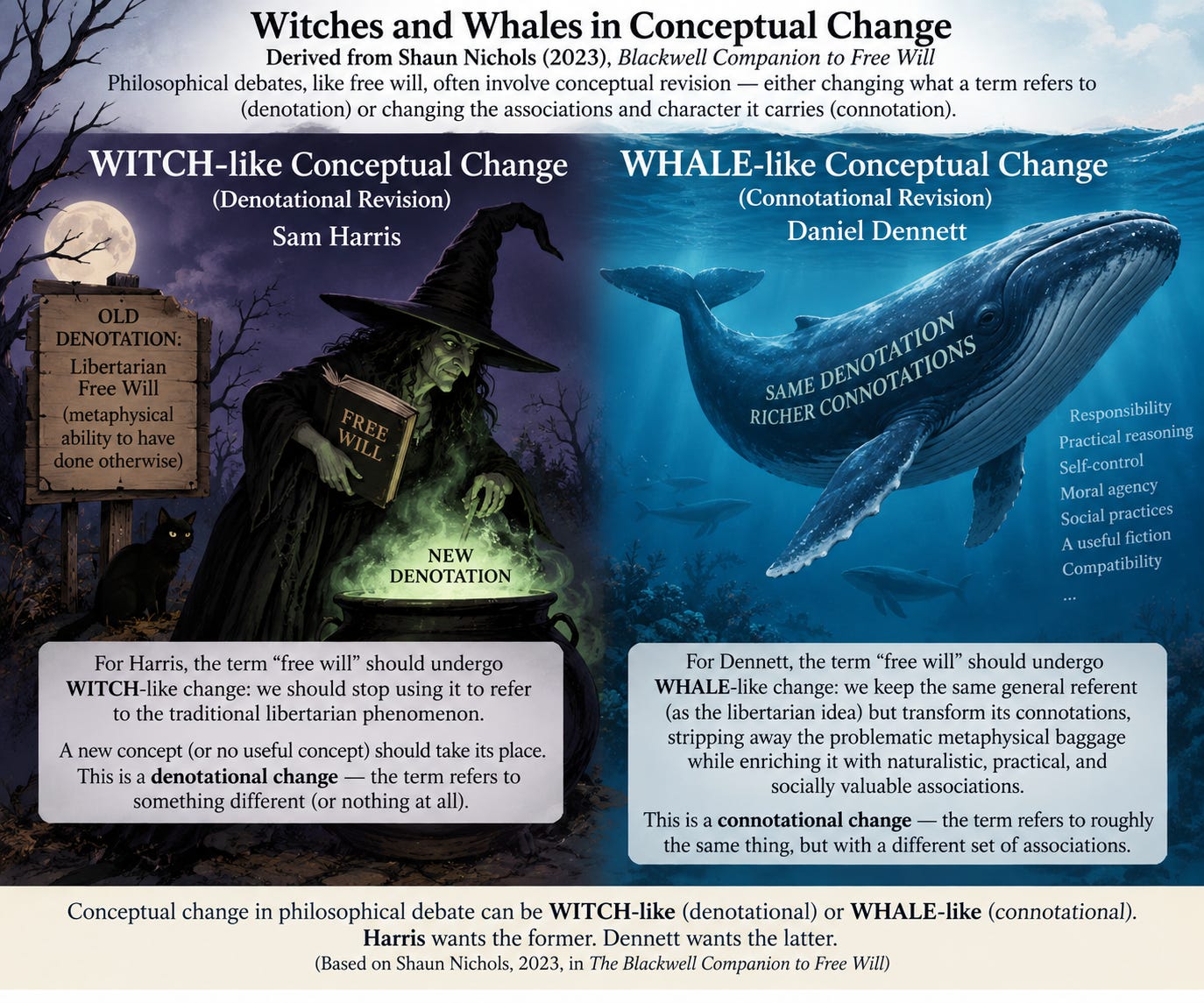
In the debate between Sam Harris and Dan Dennett, which I discussed in my Missouri Review essay, “Sleepwalking Towards Bethlehem,” the two friends butt heads. Even though they agree that the magical view has got to go away, they disagree about how it should go away. They do not use the terms I’m about to. This is my application to their debate a terminology I’m borrowing from University of Arizona philosopher Shaun Nichols, from his chapter in the 2023 Blackwell Companion to Free Will.
Dennett wants to keep the phrase “free will” but he’d like it no longer to have any magical undertones. Instead, it would change meanings and take on his new compatibilist definition. Harris, by contrast, does not want the meaning of “free will” to change; he wants it to remain the same. Instead, the change he wants is that everyone comes to realize that nobody has this magical ability, there are not referents of this concept. In Nichols’ terms, Dennett wants the concept FREE WILL to undergo a connotational revision like the concept WHALE did, whereas Harris wants FREE WILL to undergo a denotational revision like WITCH did.
Melville, like many others, took whales to be fish. But Carl Linnaeus won the day and whales were re-categorized as mammals. It’s a connotational revision because, while the meaning or connotation changes (from fish to mammal), the set of referents, the denotation, stayed exactly the same. We did not exclaim, “I guess there are no such thing as whales (meaning no such things as whales-as-fish).” Instead, we said, “I guess we wrong what about those large sea animals with blow holes to whom we gesture demonstratively and say ‘Thar she blows’. We will have to start thinking about them slightly differently.”
In the case of the concept WITCH, the connotation or meaning—something like “magical satanic outcast woman”—stayed the same; the change was that we realized nothing fit that description, no one fell under its denotation. Harris wants us to keep “free will” as meaning or connoting the magical contra-causal view. He wants us to say, “I guess there was no such thing as (that kind of) free will.” All the network of concepts that Dennett wants to replace the definition of free will with—all his responsibility-conferring criteria, Sam Harris wants to co-opt for a definition of VOLUNTARY ACTION, one compatible with determinism in the way libertarian free will wasn’t.
Which returns us to the Missouri Review’s Associate Editor’s question… the entire apparatus that Dennett outlines is how a hard determinist would define “voluntary,” in the context of free will denial.
To conclude, consider what would have happened had WITCH not undergone a denotational revision but rather an connotational one? We can be grateful that it happened the way it did, because the WHALE-type alternative would have meant that WITCH continued to denote the same set of women while changing connotationally from meaning “magical satanist” to, most likely, “outcast women” or “persecuted women” or “women who aren’t magical but whom we continue not to like.”
In fact, we came close. In 1584, Reginald Scot wrote book about witches. He wanted to argue that they existed but that they did not have all the magical powers attributed to them. He wrote: “My question is not (as manie fondlie suppose) whether there be witches or nae; but whether they can doo such miraculous works as are imputed to them,” (sic). Insofar as any degree of an attitude like Reginald Scot’s existed, it ought to be lamented. Basically, Scot would have said, “Okay, we used to think witches were magical, now we know witches are just bitches.”
Thankfully, WITCH underwent a denotational revision, instead, continuing to connote “magical satanist women.” Now, however, it has no referents—there is nothing it denotes. And thank goodness.
Allow me just to assert this faith for now. Philosophy professors usually do not merely assert this but rather demonstrate it by engaging their students via the Socratic method.
The magical definition is the one that gets the problem going, which holds that freedom of the will is incompatible with causal determinism. “To be caused is to be unfree. To be free you need to be uncaused,” i.e., you need to be able to do otherwise than the causal antecedents of your action would normally make you do. This contra-causal view is the so-called libertarian definition—no association with the specious political philosophy of Ron Paul, Ayn Rand, Rand Paul, and Paul Ryan—which says you have free will because, when push comes to shove, you always retain an ability to act otherwise than you did in fact act. You chose soup today for lunch. But, rewind the universe, and you could have chosen salad, even without any other antecedent condition changing. For example, you could still want soup but choose salad. Coming at it from a different angle, think of libertarianism as sharing the same definition that hard determinists have—namely to be caused is to be unfree; and to be free you must be uncaused. Libertarians think you can do this, hard determinists think you cannot. The libertarian definition of free will is, thus, conceived as incompatible with causation and determinism.