

Recall the last really good sunset you saw. That fiery orb of nuclear fusion, the sun, moving down through bands of luridly colored clouds, getting closer and closer to the horizon. It is easy to forget that the sun is not really moving in the way it seems to be. It’s the Earth that is moving—rotating—so that from our perspective, situated on the sphere, the horizon eventually rises up to block our view of the sun. We are rotated away from the sight of it. We know this is so—if we take the time to think about it. Yet for our language to reflect our belief in it, we’d have to say, “What a beautiful Earth-turning tonight!”
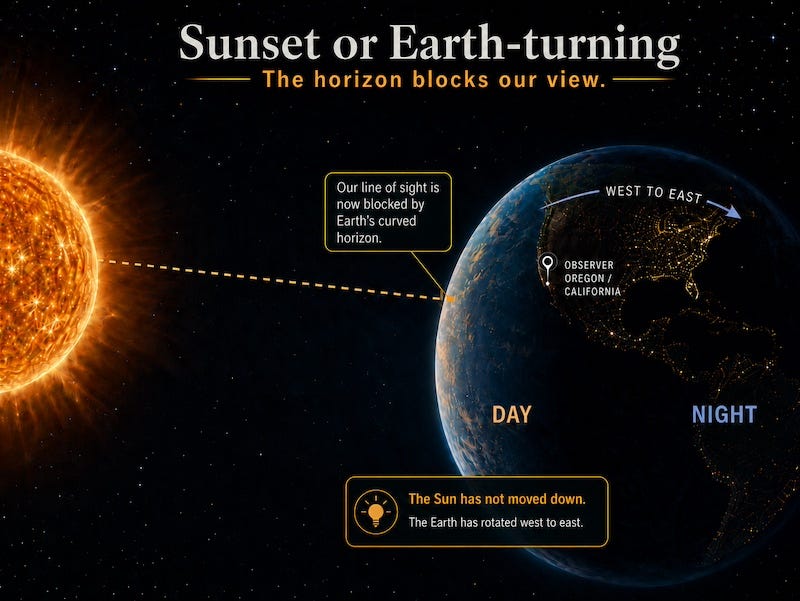
The rotation happens at 1000 miles per hour, roughly. After all, the circumference of the Earth is about 24,000 miles around. And the Earth completes a rotation once per 24-hour day. And—if I may belabor a point—since twenty-four goes into 24,000 1000 times, we know the Earth is rotating west to east at 1000 mph.
That the sun does not set and that we are spinning at 1000 miles per hour are examples of truths we know but do not believe. At least in my way of framing things. I understand this framing is unconventional, even paradoxical. But I have found it fruitful.
By logic alone it should not be possible to know something yet not believe it. Those exposed to some philosophy among my readers will have been making this objection in their minds for the last few moments. Philosophers often conceive of “knowledge” as “true, justified belief.” In other words, a person knows something when (1) they believe it to be true in virtue of proper justification and (2) the belief is also true. (About which much ink has been spilled but let us not be delayed.)
Thus, while not all beliefs are knowledge, all knowledge is a (special kind of) belief.
Knowing without believing sounds strange. More commonly, it goes the other way around—someone holds a belief without having knowledge, without being in possession of proper justification for their belief. We are inundated by news of people who maintain a set of beliefs without knowing what the fuck they are talking about, without their beliefs corresponding to anything in the real world. And then those benighted people perpetrate an insurrection against their government.
Knowledge without belief? What could that even mean?

We live in an age where much of what we know cannot be believed or at any rate is not believed. Since the Scientific Revolution that started 500 years ago, we have lived with this gap between the scientific image of the universe and the image tacitly animating how we experience the world, i.e., the commonsense or “manifest image” of the world, to use a term from philosophy of science. According to the manifest image of the world, the sun moves across the sky throughout the day, setting in the west. According to the scientific image of the world, it is not true that the sun is moving in that way; instead, the Earth is moving.
What physicists know about the nature of matter asserts that matter is mostly empty space. Those of us who know this rarely believe it.
Those of us who know free will is not real (i.e., libertarian free will is either incoherent or undermined by the truth of causal determinism) can only briefly make ourselves believe it. (For more on this, please read my essay forthcoming in the Missouri Review, titled “Sleepwalking Towards Bethlehem,” due out in mid-June.)
Denying free will of oneself—or, generally speaking, trying to believe what you know but don’t normally believe—can cause a kind of vertigo. But it’s temporary. Since it’s a dizziness that you get because you’ve been thinking too much, I’ve taken to calling it “armchair vertigo.” And I also call it that because it goes away once you get out of the armchair of philosophical reflection, and you engage again with life. Simon Blackburn coined the phrase “inductive vertigo” for the feeling one gets when one appreciates David Hume’s so-called skeptical point about the mere probability of the laws of nature, not their absolute certainty. (I won’t pause to explain; just wanted to give credit where credit is… you can finish that sentence yourself.)
In day-to-day, normal life—that is, while not suffering from armchair vertigo—the state free will deniers are in consists paradoxically of knowing without believing. It’s the believing what we know that makes us dizzy.
There are cases where believing what we know causes anxiety. I’m thinking of the widespread phenomenon of “death denial,” and also of the truth of the climate change crisis. In both cases, we know it, but we can barely bring ourselves to believe it—at least judging by our actions or lack thereof. We would live differently if we really appreciated the fact of our inevitable death. That’s why a brush with death so often brings about significant life changes.
I’ll conclude this brief introduction by merely gesturing in the direction of other topics which I’ve been able to relate to this phenomenon of knowing without believing. Self-deception, as a topic in psychology but also philosophy, is related. When you act against your better judgment—as in procrastination and other instance of so-called weakness of will—you are not believing what you know. Your better judgment is that you ought to do X, that it would be best to do X, but you end up doing not-X. This action against your better judgment is an indication you actually believed something else was best to do because that was what you ended up doing.
More: the problem of publicity for utilitarianism; the climate crisis; Hume's problem of induction; many possible worlds theories; free will denial; optical illusions like the Mueller-Lyer illusion. I explore them all in the same manner as the free will essay.
Stay tuned.