
BTS: The Ancient Greeks had No Concept of Free Will Because They had No Concept of Will
Behind the scenes: I cut for length this perfectly good (albeit challenging) section before submitting the version which The Missouri Review accepted.

Many of my undergraduates begin their essays on free will by writing something like: “The problem of free will has been thought about by humans since time immemorial.” Not only is that passive construction, it’s also not true.
Socrates never mentions free will and it does not appear in the works of Plato or Aristotle, or so says classicist and philosopher Michael Frede. In his book, A Free Will: Origins of the Notion in Ancient Thought, Frede writes, “[I]f we look at Greek literature from Homer onwards, down to long after Aristotle, we do not find any trace of a reference to, let alone a mention of, free will.”
Julian Jaynes’s The Origin of Consciousness in the Breakdown of the Bicameral Mind popularized the hard-to-believe idea that the pre-Homerian Greeks heard what we would call the inner voice of conscience as if it were a god’s voice in their head. In Homer’s Iliad many significant moments, for example, actions that turn the tide of a battle—but also insignificant moments of quotidian agency between husband and wife—are described as caused not by the Homeric heroes themselves but by the gods acting through them. It was as if the gods played puppeteer standing over the scene like over a game board, pulling the strings connected to Hector and Achilles.
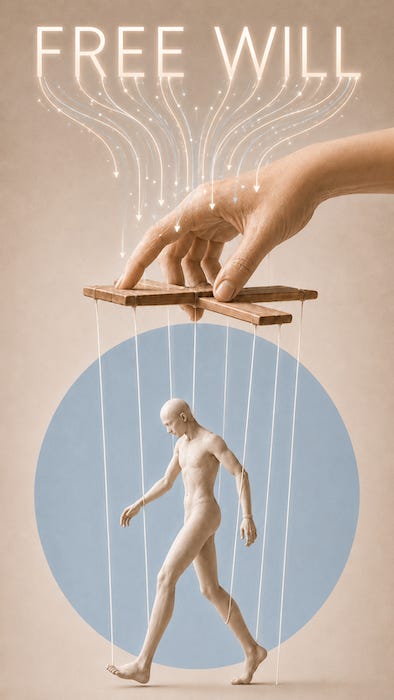
For the moment, we may put Jaynes aside as overly speculative, if still evocative. According to Frede, the reason Plato and Aristotle do not have a concept of free will is because, “[n]either Plato nor Aristotle has a notion of a will.” That’s right. They did not make use of the concept of will, much less free will.
Frede: “[N]either Plato nor Aristotle has a notion of a will.”
Plato and Aristotle’s famous “tripartite view of the soul” is grounded in the idea that there are distinct forms of motivation which often come into conflict with each other and therefore “must have their origin in different capacities, abilities, or parts of the soul,” Frede writes.
According to these ancient Greek thinkers, the collected parts of a human soul can be thought of metaphorically along the figure of the horse-drawn chariot. The charioteer is Reason, gripping the reigns of two horses, Desire and Passion. As a metaphor, this strikes us as not so bad today. It looks a lot like our preferred folk metaphor of a homunculus at a control panel patched into the central nervous system. But the ancient view is more complicated than the metaphor suggests, and stranger too. Frede says the ancient thinkers had “a highly specific form of wanting or desiring, in fact, a form of wanting which we no longer recognize or for which we tend to have no place in our conceptual scheme.”
In other words, we don’t think of ourselves, of our agency, in the same way as the ancient Greeks did. And we may never be able to. But the way they thought can be made understandable from the outside, if not usable, so to speak, from the inside.
Frede says it’s safe to assume that Plato and Aristotle thought human beings at least sometimes acted voluntarily, or because they desired to so act, that they “willed” certain actions, et cetera. The ancient Greek “folk” (non-philosophical layperson) had a commonsense psychology in which they attributed intentions and so on to each other. But the philosophical theory which Plato and those other philosophers posited to explain this commonsense folk psychology is what the modern mind does not, perhaps cannot, share in.1
Aristotle does not share our notion of a will as essentially spontaneous, an uncaused causer.2
Consider the Latin velle, the German wollen, and “to will” in English. They all mean something like wanting or willing. The ancient Greek word boulesthai is closely related and yet, Frede says, should not be translated as “willing” because it signified a very specific form of wanting conceptually distinct from our sense of “willing.” Nevertheless, we lack any better term to translate it into.
According to Frede, boulesthai is “a form of desire which is specific to Reason.” “It is the form in which Reason desires something. If reason recognizes, or believes itself to recognize, something as a good, it ‘wills’ (boulesthai) or desires it. If Reason believes itself to see a course of action which would allow us to attain this presumed good, it thinks that it is a good thing, other things being equal, to take this course of action.” And, if it thinks that it is good to do something, then Reason does it. Or Reason makes us do it.
The ancient view assumed that “reason by itself suffices to motivate us to do something. This is an assumption which is made by Socrates, Plato, Aristotle, and the Stoics.” But it is an assumption that is incommensurate with how we think about motivation and agency today. We are all followers of David Hume today insofar as we think that between reason and desire only desire is motivating on its own.
We are all followers of David Hume today insofar as we think that between reason and desire only desire is motivating on its own.
In our understanding today, my reason can recognize something as good to do and yet I will not do it unless I also want to do it, or unless I desire to be reasonable. Hume wrote that “it is not irrational to prefer the destruction of half the world to the pricking of my little finger.”
Hume wrote that “it is not irrational to prefer the destruction of half the world to the pricking of my little finger.”
Let’s unpack that double negative. Hume is saying it’s possible that I’d rather avoid a little pain than prevent the destruction of half the world. It’s conceivable I would not switch one for the other; that is, I might let half the world be destroyed rather than endure a little pain in my finger. Preferring is a key notion here. What we prefer is a matter of taste in our schema today. For the ancient Greeks, what was preferable was a dictated by reason.3
My reason can recognize something as good to do and yet I will not do it unless I also want to do it, or unless I desire to be reasonable.
My reason can recognize something as good to do and yet I will not do it unless I also want to do it, or unless I desire to be reasonable.
That is our modern intellectual inheritance. Those preferences would sound like nonsense to the ancient Greek philosophers. The difference is Hume has limited “rational” to mean only instrumental reason. Being rational can help you instrumentally to achieve your goals, your values, your desires. But establishing what is valuable is not a part of rationality when the latter is conceptually limited to be only instrumental reason.
What, then, is value in our post-Humean paradigm? For us, value is just a matter of desire or preference, with all the subjectivity and relativism that this implies. If value were arrived at via reason instead of desire, value would be objective—it would be something you could be wrong about instead of being something which depends as it does today on subjective desire wherein if you think it’s good then it’s good.4
Two things separate us most remarkably from the ancients. One is that they lived in a time 1500 years before the moral relativism we embrace today was even conceivable. The other is their lack of an important role for will in their understanding of human action. We, by contrast, have made an apotheosis of will; we’ve turned it into the end all be all.
Socrates’ view is especially foreign to us because he specifically denied the conceptual possibility of “weakness of will,” or akrasia, that is, situations in which we act against our (better) judgment. In cases of weakness of will, like bad habits or procrastination, our reason tells us a task is important or urgent but when we do something else instead, we demonstrate, according to Socrates, that we actually believed the other thing—the thing we actually did—to be more important, more valuable.
A student going to a party rather than studying the night before a test demonstrates he values the party more than studying. Socrates would categorize procrastination as a failure of rationality, an evaluation5 of what would be good to do, an evaluation which was objectively false. His reason or reasoning was wrong (indeed, his rational evaluation of the pros and cons of the various options open to him was wrong) because it motivated him to do the less objectively reasonable thing.6
Contrariwise, after Hume, we say the student’s reason was correct (he reasoned that he should not go out but instead study the night before the test); he just didn’t want to do the reasonable thing. Acting against your better judgment was impossible according to Socrates, because Reason does what it views as best done. In those case where it might appear you acted against your better judgment, you were in fact judging what you did to be better—best all things considered—but, Socrates would say, you were simply wrong about that.
The paradigm we live in today describes the case differently. It says: our reason did indeed evaluate the undone course of action (about which we procrastinated) as the most valuable, and therefore the thing we ought to do, but we did not want to do it, and so we did not do it.7
Let’s now compare the figure or trope each epoch or paradigm prefers to describe human agency. The two-horsed chariot for the ancients and the homunculus at the control panel for we moderns.
The first task is to understand the chariot metaphor in the way the ancients did rather than how we are inclined to. Frede says, “modern readers apparently can hardly help thinking of cases of acute mental conflict,” when thinking of the charioteer metaphor. That is, we project our homuncular conception of the mind onto Aristotle and the two-horse chariot setup. “We sit there anguished, tormented, torn apart by two conflicting desires which pull us in opposite directions, while we try to make up our mind which direction to take,” (italics added).
But that’s not what Plato meant with the charioteer metaphor when he introduced it in The Republic. Standing in for Reason, the charioteer, according to the ancient understanding, himself has a desire; he desires the good. (His task is to train his horses to also go in that direction. Horses do not act on the basis of reflection or wisdom; they act out of habit or instinctively; but they can be trained to act in line with what Reason judges proper.) The ancients understood that to cash out the italicized “make up our mind” a few sentences above, we would have to invoke another metaphorical charioteer inside the first charioteer. The ancient paradigm avoided this infelicity by giving Reason a desire of its own, capable of motivating us on its own. The charioteer has a telos or drive of its own, which is sufficient on its own to succeed in motivating action.
According to the ancient Greeks, when we do what we believe is best, it’s because we saw it was best, and not because we saw it was best and also had this other thing, a will, which decided to do it. The addition of a mental event, an extraneous willing, is what gets the homuncular regress going. Aristotle’s view makes sense at just the point ours starts to go awry. Indeed, Aristotle was the first to oppose the notion of a homunculus as leading to an infinite regress, although he opposed it in biology as a bad theory of the life force a sperm brings to an egg.
Conceiving of the mind in the homuncular manner is to conceive of self-consciousness as an autonomous monitoring and control system and conscious will as an uncaused causer. The ancient conception of the mind was different. The ancient’s conceived of the mind as a collection of desires or motivating drives (that is, the rational charioteer and nonrational horses are all drives, drives of different kinds), each in competition with the other drives to get the creature to do what each drive innately wants the creature to do. No uncaused causer anywhere. No “spontaneous will” as uncaused causer. And so no problem of free will in the way we moderns understand it, which is as a conflict between belief in an uncaused causer and the truth of causal determinism. QED.
And, insofar as the ancient folk notion was inchoate and, if thought through, would end up looking like the philosophers’ view, then our systems’ incommensurability is pervasive.
Spoiler alert! For those who know something of Aristotle, the reason I will eventually come to below is that Aristotle philosophically rejected the notion of a homunculus, which he did in the context of explaining human sexual reproduction.
Hume says it is not irrational. (It’s not irrational to prefer that half the world be destroyed rather than I suffer a tiny bit.) But what I interpret that to mean is that rationality does not determine value, desire does. Rationality becomes instrumental rationality. Instrumental rationality can tell you the best way to achieve your goals. But it does not and cannot determine the goal, what’s best… Or as we say today, what you want.
Footnote only for those with ears to hear it: Frede here rhymes, as it were, with Robert Cummings Neville’s work, which I’ve explored elsewhere. They both came to compatible and counter-to-mainstream views of the ancients and modernity’s relation to the ancients’ paradigm. Neville says that Galileo began the sundering of what the ancients had unified together—Galileo sundered the quantitative and qualitative forms of cognition including thinking, perceiving and knowing. Indeed, it is sometimes called Hume’s Fork—the fact that we divide the world into what can be known a priori and what can be known a posteriori… or between deductive reasoning and induction-based evidence-gathering. These are different distinctions but can be put into two columns to show commonalities. Quantitative, empirical, a posteriori versus qualitative, syllogistic, a priori. To see how, consider that laws of nature for Aristotle and still for Descartes (but not Newton) were arrived at via speculative intuition not induction.
I could call it a “subjective evaluation” but that might be misleading because, really, it is an attempt at an objective evaluation that the evaluator just gets wrong, ends up being wrong about.
If “objectively reasonable” strikes you intuitively as off kilter, as if the phrase were a contradiction in terms, then that is evidence, I say, that you live in a different paradigm from the ancient Greeks.
We did not do the thing we ostensibly knew to be best.
Excellent piece.
Oh. This is good. But I’ll have to finish reading it after the HIIT class I freely willed to take is over. (This popped up right before as I was stretching, but the first line hooked me!)