

This is the first part in a five-part series.
Two years ago, my fiancée told me that I’d been sleepwalking and carrying on full-fledged conversations with her each night. When Kelly first relayed this, her brow twitched slightly with what I took to be suppressed irritation.
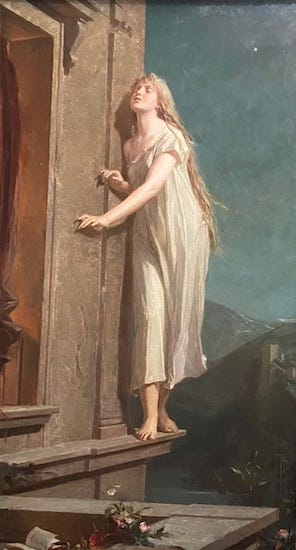
These mornings, I never remembered anything about whatever it was I’d done overnight. After all, somnambulism is a classic example of automatic behavior. Yet, the archetypal image of the sleepwalker—nightcap with drooping tassel, eyes closed, arms outstretched in front, wrists bent down—is wrong. Sleepwalkers engage in complex behavior: they might cook a meal, drive a car, carry on a conversation, murder a relative—all without the accompaniment of consciousness.
It raises the question: if I’m not conscious, how am I seemingly able to adapt to changing circumstances? Who was talking when I was conversing? As Kelly and I sat up in bed that first morning, her pent-up prickliness made me acutely aware of the score between us. What was the regrettable conduct I unfreely enacted each night, but for which I must nevertheless accept responsibility? Evidently, I had been peeing in the closet.
During the first night, Kelly says, my rustling woke her up, and she asked me what I was doing. “Nothing,” I said. “Going to the bathroom.” But she could see I was standing in front of the open closet and said, “That’s not the toilet.” “Yes, it is,” I said, sounding offended, while gravely continuing to conduct my business. We would learn later why it’s said not to wake up a sleepwalker. Although it’s like a preprogrammed routine is being run, the person’s capability to react in complex ways can remain, but often only in limited form. I could interact with Kelly, for instance, but likely only to counteract her attempts to thwart me. If you attempt to impede a sleepwalker, they might instinctively find it aversive and—one article suggested—react impulsively, yet they’d be without the benefit of consciousness to reign in their anger. That was the theory anyway.
Luckily for Kelly and me, my nonconscious self was more likely to be cavalier and arrogant than angered by impediment. While following the going-back-to-bed algorithm, I responded to Kelly’s protestations, she reports, by uttering “an aloof grunt of bemused recognition.” During the night of my second episode, when she again informed me that I was standing at the closet, not the commode, I let go another self-satisfied, haughty grunt. But I apparently persevered in my task, because she could hear the unmistakable evidence—the damp applause—of my misguided micturition. A faux fancy language affords me distance from disgusting deeds.
The third night Kelly screamed at me, “ARE YOU AWAKE?!” “Yes,” I said. In that moment, she struggled with what to conclude about my inner mental world. For I was passing the Turing test, so to speak, yet she didn’t know if I was actually conscious. As we found out in the morning, I hadn’t been.
When I asked her to recount the events for me once more (in furtherance of writing this essay), I noticed her brow involuntarily furrowed again. The biggest irritation, she said, was having to clean up the soggy mess after I’d already roboted back to bed.
“That sucks,” I replied, dutifully. Yet, moments later, I caught myself feeling uninvolved again, like I hadn’t done it. I knew I had done it; I took what she said for the truth. But I did not feel that belief in my body. Usually when I’ve done something wrong, my self-criticism is more despairing. The knowledge of the injured party’s disapprobation is more—I don’t know—piercing. I get a nauseating knot in my stomach. But this time, my understanding that I was responsible for Kelly’s aggravation was entirely intellectual and bloodless.
Because I have so tenuous a connection to what I’ve done while sleepwalking, I find it easy to be glad of my inopportune nocturnal emissions. If I had not sleep-peed in our closet, then I would not possess such a good example of an action for which I take responsibility, but which I did not do of my own free will. It’s been a fascinating experience. It’s like when, at the dentist, I cannot keep my tongue from pressing against the hygienist’s elongated mirror.
Above all, sleepwalking gave me a concrete path into wondering what it’d be like as an experience to deny free will, as a small number of public intellectuals have recently done. It was weird enough to think that I had carried on a conversation without free will one, two, or three times. What would it be like to think every action you undertake lacks free will? Not just outbursts but even conscious decisions made after careful deliberation. What would it be like to believe that each thought in one’s stream of consciousness was an effect of previous causes?
For Stanford biology professor Robert Sapolsky, for instance, what is the experience of denying his own free will like? Sapolsky is convinced we do not have free will; so, from his perspective, he knows it. But he’s admitted he catches himself reverting to the default setting of free will belief every time he nonchalantly accepts responsibility. “Someone says, ‘You’re dressed nice today,’ and I say, ‘Thanks,’ as if I had anything to do with it,” Sapolsky joked during a guest appearance on NPR’s Radiolab.
When Sapolsky manages to believe what he knows—when he is actively remembering that he doesn’t have free will—how does his day-today self-conception change? Is denying free will bad for you? Or does it increase well-being? I’m talking about psychological effects. I became much less interested in the classic philosophical arguments for and against free will. Released from responsibility, does a free-will denier run amok, his face frozen in a gleeful rictus? Or does he lose all motivation and succumb to fatalism, thinking it doesn’t matter what he does? Would denial, as Sartre worried, serve as an excuse for bad behavior? Perhaps, as Sapolsky imagines, pervasive denial would bring about a fairer, more just, less cruel society, “a giant leap forward in our moral progress,” as he’s said. How would our thinking change if we cleansed our vocabulary of the term “free will”?
When Sapolsky and others deny free will, they don’t mean that everything is destined, that what will be will be, no matter what we do. It’s not fatalism necessarily. The precise logical implications of denial are, however, not a matter of what Sapolsky might want them to be; they are a matter of science and logic and will depend on arguments and experimental evidence. And, as it turns out, there is already an empirically informed debate going on.
My research into the psychological implications of free-will denial led me to novel places on the intellectual landscape: to a confrontation with bodies of knowledge called “informational existential threats,” to the conceptual affinity between progressive political opinion and freewill skepticism, to the idea of an Area 51 for anti-free-will research, and finally, to the existence of brain-scanning technology that can read the inner contents of your mind and know what you are going to do before you know.
***
When I sat down in my office to start my research, the first thing I noticed about online pictures of Sapolsky was the compassionate twinkle in his eyes. Framed by long curly gray hair and a gray Garibaldi beard, Sapolsky’s eyes sparkled like quartz in the Tolstoian rocky crag of his sun-wrinkled face. A specialist in neuroendocrinology, he’s spent thirty sunny summers in Africa studying simians. (Sorry! I couldn’t control myself.) Returning to the same troop of baboons each year, he’d observe their behavior, tranquilize them, and take blood samples. Sapolsky found, among many other discoveries, that baboons ranking low in the troop’s dominance hierarchy had chronically elevated levels of stress hormones (glucocorticoids) with concomitant negative effects on health, like hypertension, and on behavior, like an increase in isolated sulking and displacement aggression. Sapolsky estimates that nearly 50 percent of all violence among his troop of baboons is displacement aggression. Shit, as we know, flows downhill. “A high-ranking male loses a fight and so chases a subadult male, who promptly bites a female, who then lunges at an infant,” Sapolsky has written. The more a baboon displaces aggression after losing a fight for rank, Sapolsky says, the lower his glucocorticoid levels are when the good doctor, sans sun hat, tests his blood.
That explanation—a diminishment in rank causes stress hormones, which cause the loser to punch down to gain relief—is only one example from Sapolsky’s immense storehouse of explanations of primate behavior. Sapolsky’s 2018 bestselling book, Behave: The Biology of Humans at Our Best and Worst, exhaustively explores the myriad causal factors relevant to the conduct of your behavior: from your mix of neurotransmitters nanoseconds before a given action, to the moral emotions bequeathed to all of us by our highly cooperative hunter-gatherer forebears; from your stress hormones thirty minutes ago, to those of your prenatal environment; from the sexual selection processes at work in your grandparents’ mating rituals, to the organizing principles—whether individualistic, communitarian, or honor-based—of your great-great-great-grandparents’ culture. Perpetually harried in his speech and even apparently in his ellipses-filled emails, Sapolsky—a 1987 MacArthur “Genius Grant” recipient—is charming and often approaches silliness. He turns serious, however, when he addresses what he calls the “appalling moral affront” of a society that continues to believe in free will. “The injustice and harm perpetrated by our justice system’s anti-scientific belief in free will should keep us up at night screaming,” he said on another episode of Radiolab. Sapolsky has staked out the most uncompromising position against free will in the public sphere. “We are nothing more or less than the cumulative biological and environmental luck, over which we had no control, that has brought us to [where we are],” he writes. In October 2023, Penguin published Sapolsky’s latest book, which is about living day-to-day with free-will denial, titled Determined: A Science of Life without Free Will. Having established in Behave that every human behavior has a cause, Sapolsky writes in Determined about the potential consequences of society-wide free-will denial and how to integrate those implications into our self-understanding.
After my sleepwalking episodes began, Kelly cracked open my copy of the eight-hundred-page Behave, and I started reading a galley copy of Determined. We would compare notes at our ritual of Sunday three o’clock tea, recommended by our premarital counselor. I also read the eighty-page Free Will by Sam Harris, another denier. Harris is a multi-topic public intellectual, unaffiliated with any university, and…
The next part, part two, of this five-part series, will arrive in your email inbox in one week. If you wish to read ahead, here’s part two now.
Update of August 2026: Newly added paragraph by paragraph summary of “Sleepwalking Toward Bethlehem,” as well as a study guide and a source list for further reading.
Do you wash your hands, or do they wash each other?
Interesting. I will say this. You did make me think past the reflexive denial.