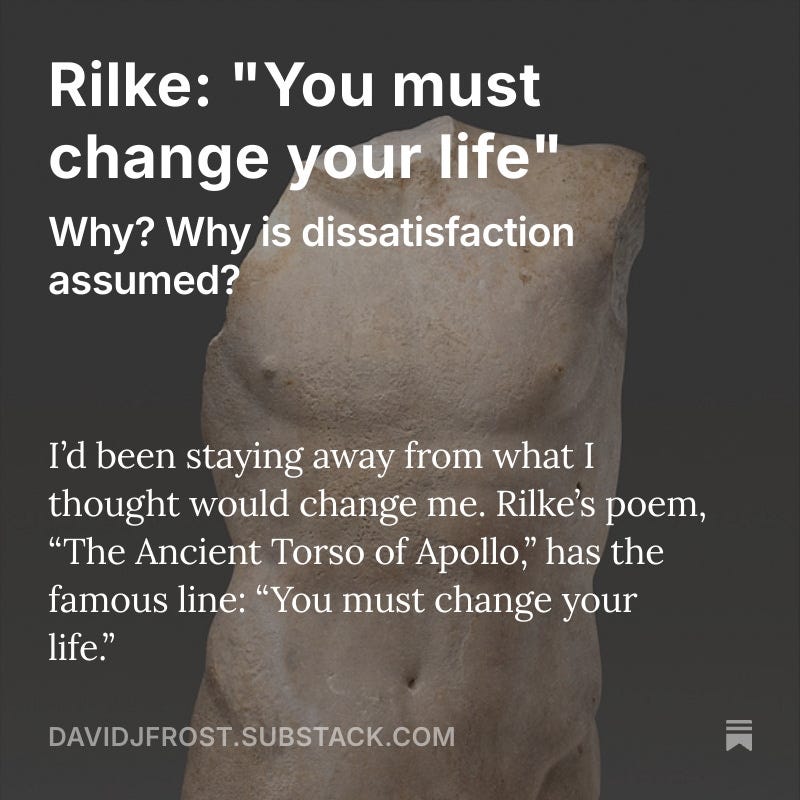
Rilke: "You must change your life." But wait, why?
Why is dissatisfaction assumed?

I’d been staying away from what I thought would change me. Rilke’s poem, “The Ancient Torso of Apollo,” has the famous line: “You must change your life.”
Why? I mean, Yes, yes, I know. But why?
I rifled around my bookshelves and finally located my Rilke. When I had the poem in front of me, I’d re-read a line if it did not stick, if I was skimming. I told myself: diligently read the poem; do not let yourself lose focus. If I found I was thinking of something else, then I backtracked and started the line again. Sometimes I went to the beginning of the whole stanza and sometimes I started over from the beginning of the whole poem. I needed to read this poem right. After all, this was the famous poem that said, “You must change your life” and so I’ll be damned if when I get to that line I’m fucking around and don’t let that line work on me, don’t let it change my life.
[T]his was the famous poem that said, “You must change your life” and so I’ll be damned if when I get to that line I’m fucking around and don’t let that line work on me, don’t let it change my life.
I kept reading and then, distracted, started over. Using my finger, I blocked my sight of the next stanza so I could not move ahead until I was completely self-aware and present and ready for the next line to take complete possession of my consciousness.
The poem describes an ancient Greek statue of Apollo, which is a ruin now, but the statue does not lack what a building lacks when a building is a ruin. A building in ruins may strike us as art but it does not strike us as a domicile. This time-ravaged statue, on the other hand, continues to evoke life. The archaic statue of Apollo has lost its head and is now a torso only. But, according to Rilke’s poem, the torso nevertheless remains whole and entire, still with its head. Or, at least, it’s as if the head were still there. Otherwise, the torso would not have the effect Rilke says it’s having on him.
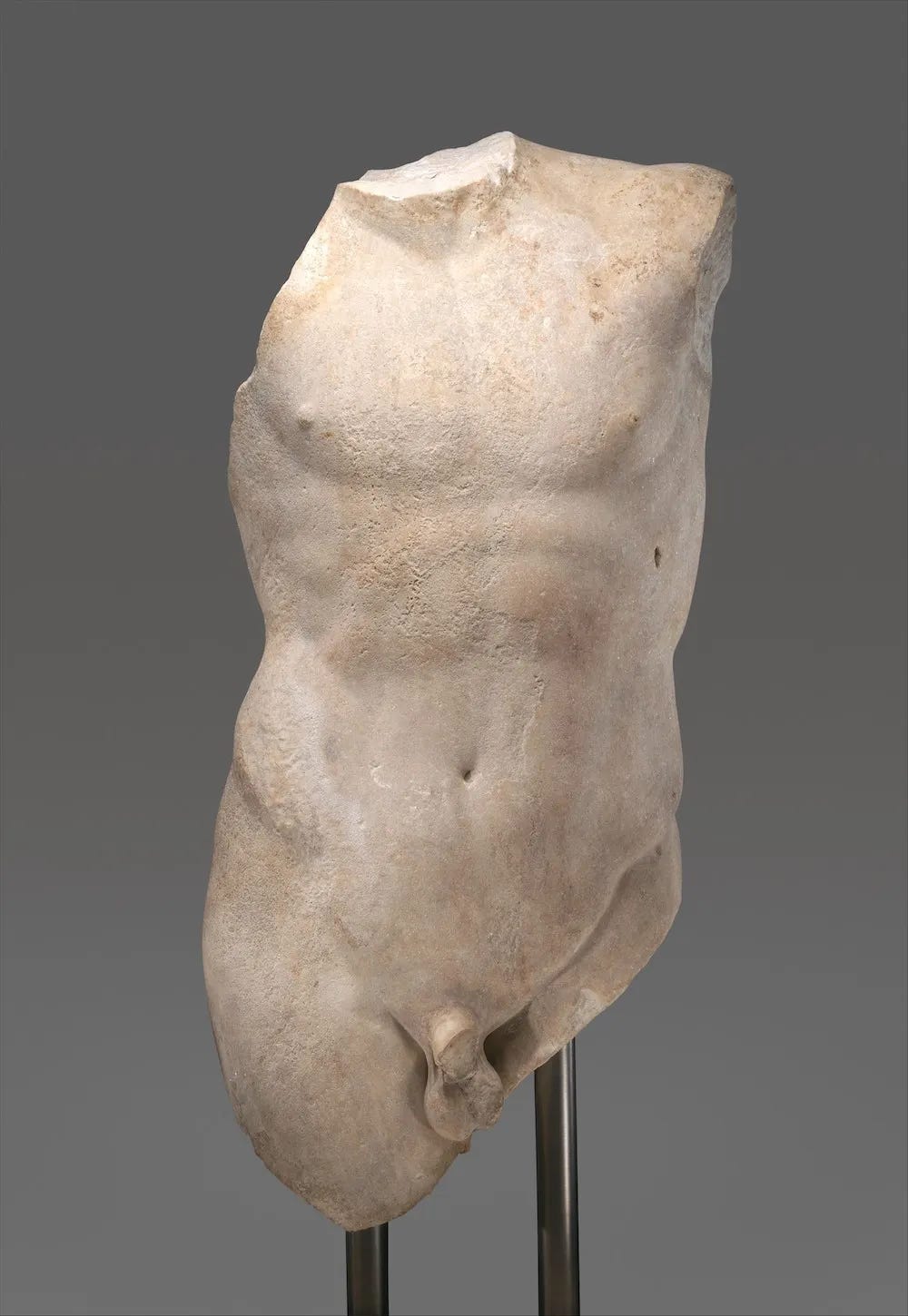
The torso is “still suffused with brilliance from inside / like a lamp, in which his gaze”—the gaze from Apollo’s missing head, face and eyes—the gaze still “gleams in all its power.” Apollo’s smile runs “through the placid hips and thighs…” like the Mona Lisa smile, except Apollo’s smile is, in the curve of his hips, invisibly visible while Mona Lisa’s almost-not-there, slight smile is visibly invisible.
Then it came to me that “You must change your life” is going to be the last line. When I hear in my head the still un-read phrase, “You must change your life,” I somehow hear what it is rhymed with. I hear it but I cannot make it out. My fingers still block it from my sight. I seem to know that it comes on the stage clothed in rhyme, clothed in its rhyming with an earlier line.1 Is it going to rhyme over the gap between “life” and “otherwise” and between “life” and “thighs…”?
I continue reading the poem, which goes on without yet giving me the famous line. The stone does not seem “defaced,” Rilke writes, even though it is lacking its head and face.
The statue—the idea of the statue—“burst[s] like a star,” “from all the borders of itself…” And while you look at it, “there is no place / that does not see you.” And then it comes.
“You must change your life.”
It just sits there. It comes by surprise and, I had forgotten, it doesn’t rhyme. The poem is over. The resonance of the last syllable fills the silence of the after-poem.
Does the poem tell me how or why looking at this headless statue means I must change my life? What is telling me to change is nothing other than the experience of seeing, of seeing myself, almost as if in a mirror. It is the experience one has of having no place to hide. “There is no place / that does not see you.”
In other words, the faceless statue is such a completely successful work of art that even without eyes it still sees you. It sees you in a penetrating way, leaving you exposed. When you experience art, you experience yourself in a way such that there is nowhere to hide. You look into the artwork and the artwork looks back into you.
And when you see yourself in this undisguised way, what follows? What happens? Answer: You are motivated to change your entire life.
But I disagree. I don’t buy it.
Before reading, my mind had sat crouched like a catcher behind the plate pounding his fist in his glove. Come on send it right here. Throw a strike right down the middle. Let it mitt-crack its way into my mind.
I wanted to take Rilke’s advice. I wanted to change my life. And I wanted the poem to do it, as I want all the culture I “consume” to do for me and to me. Indeed, I was preparing the ground of my psyche to get the most out of the poem and really let it change my life.
But it didn’t. It didn’t change my life. Many things that I want to change my life or just improve it… have not been able to do so. That’s the reason I’ve been avoiding these podcasts which would obviously interest me. Because I no longer liked the feeling of expecting epiphanies and being disappointed.
And now I am pleased. I am getting something out of reading this poem after all! I know I am getting something out of it because I had a critical thing to say about Rilke. I was not simply swamped.
My critical thing to say is, Why must seeing oneself lead immediately to wanting to change one’s entire life? That is to say, why is dissatisfaction assumed? Why can it not be that after the stunning experience of seeing oneself undisguised we accept ourselves as we are and with love and forgiveness?
Why must we want everything to be different? When it comes to “ourselves” or “our life,” why is the obligation always to change?
Perhaps instead we ought to come to terms, ought to embrace, ought to digest, ought to integrate2, ought to synthesize, ought to sublimate, ought to aufgeben. That’s Hegel’s word, often translated as sublimate, which means to surpass by integrating. Overthrow or come to terms?
When facing ourselves and our lives as reflected in the successful work of art, I do think we ought to aufgeben, we ought to go through and beyond what we see there. Of course, we will still be where we are and who we are. But we will see it all as if for the first time. As T.S. Eliot writes:
“We shall not cease from exploration
And the end of all our exploring
Will be to arrive where we started
And know the place for the first time…”
Coming to terms is a kind of change, but it is unlike the change the poem demands. Rilke’s commandment strikes me as off kilter, or wrongheaded. “Here’s you and here’s your life. You must change your life.”
Instead, when you hear, “Here is you and here is your life,” you could say, “Oh, interesting. I am that way aren’t I? That explains a lot.” Thoughts of this kind serve to integrate the new information, the new self-awareness which contemplation of good art offers. Integration is an arrow which points in a different direction than the direction pointed to by the arrow of the declarative “You must change your life.” But the integration will still involve change, motion, transformation. Integration is a vector. It still changes you in a way. The self-awareness changes you from the inside-out, so to speak, rather than from the outside-in.
And now will I return to listening to podcasts that I know are good for me? Good question. The answer is I got something out of Rilke’s poem even if, paradoxically, it wasn’t that I must change my life.
As Nietzsche wrote of the philosopher, we might say of any cultural product:
The philosopher supposes that the value of his philosophy lies in the whole, in the structure; but posterity finds its value in the stone which he used for building, and which is used many more times after that for building—better. Thus it finds the value in the fact that the structure can be destroyed and nevertheless retains value as building material.
The end.
Postscript:
Recent English translations of Rilke are still protected by copyright so here’s the original German. With my own amateur translation, mostly literal, with a touch of artistic license.
Archaischer Torso Apollos
[Archaic Torso of Apollo]Wir kannten nicht sein unerhörtes Haupt, We cannot know his head, unheard-ofdarin die Augenäpfel reiften. Aber where his apple eyes ripened. Butsein Torso glüht noch wie ein Kandelaber, his toros still glows like a chandelier,in dem sein Schauen, nur zurückgeschraubt, in which his gaze, merely glancing down,sich hält und glänzt. Sonst könnte nicht der Bug persists and shines. Otherwise, could not the curvedder Brust dich blenden, und im leisen Drehen chest dazzle you, and along the soft turningder Lenden könnte nicht ein Lächeln gehen of the loins, could not flit a smilezu jener Mitte, die die Zeugung trug. to that center, which sustains conception.Sonst stünde dieser Stein entstellt und kurz Otherwise, this stone would stand disfigured and shortunter der Schultern durchsichtigem Sturz beneath the shoulders' transparent plungeund flimmerte nicht so wie Raubtierfelle; and would not shimmer so, rippling like the hide of a beast of preyund bräche nicht aus allen seinen Rändern and would not burst forth from all its bordersaus wie ein Stern: denn da ist keine Stelle, like a star: for there is no placedie dich nicht sieht. Du musst dein Leben ändern. that does not see you. You must change your life.
Rainer Maria Rilke, Frühsommer 1908, Paris
Turns out it is only in the original German that the line endings rhyme, following an A-B-B-A rhyme scheme for the first two stanzas, then for the last two, A-A-B and A-B-A. In German, “borders” and “change” rhyme: “Rändern” and “ändern.”
Integration not repression. Jung advised us not to repress our animal instincts as Freud had it, but to integrate them, to integrate one’s shadow. Repression leads to the return of the repressed, to pathological acting-out of what was repressed. A man can repress his capacity for violence, but it will make him self-hating and resentful, and will finally explode into displacement aggression and violence anyway—ungoverned violence. Or a man can integrate his capacity for violence into a hierarchy of values, govern it so that he is violent only in defense of the defenseless or in the pursuit of justice or in competition with his equals or betters. A harmless man is a not a good man. A good man must be capable of harming an unjustly violent man—as retributive punishment or deterrent, or just as a sufficiently violent counterforce to defend the defenseless against the ungoverned man’s unjust violence (unjust violence is violence not integrated into a values hierarchy). This unjust violence is, we know, fundamentally sourced deep inside the ungoverned man, sourced either in self-hatred or in weakness, in an inability to master oneself, or in resentment and ignobility. In other words, how I decided to change my life was to take up boxing.