

Free will plays a nefarious role in denying death benefits to surviving family members of an office who commits suicide. In a paradigm still credulous of free will, physical causes are more often allowed to be deterministic and irresistible, while psychological causes, like thoughts and desires, are causal influences you are supposed to be able to resist with your free will.
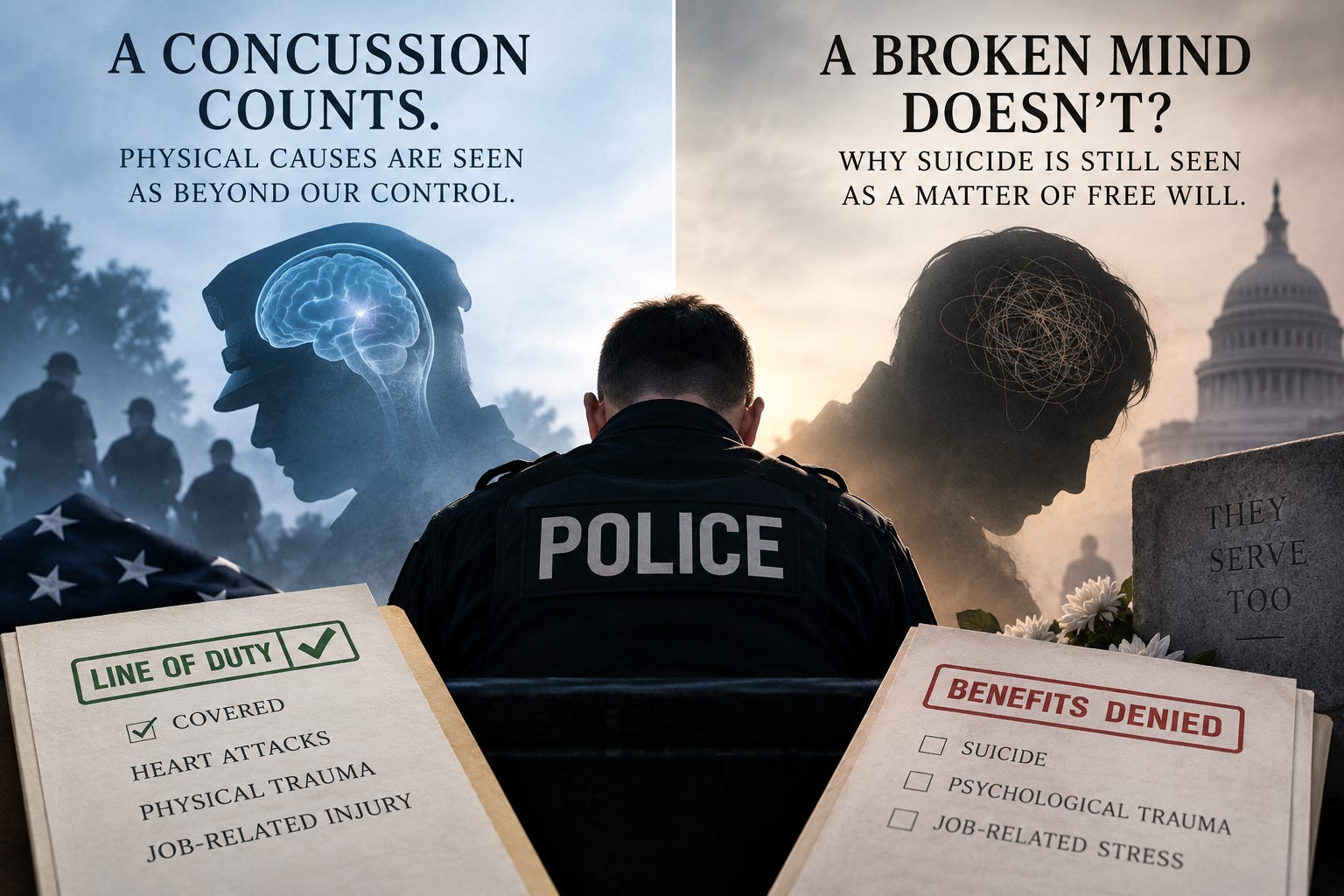
Dangerous public service jobs, like firefighting, law enforcement and the armed services, pay survivor benefits for deaths that occur in the line of duty. Both the military and the police have an operating presumption that fatal heart attacks should be categorized as line-of-duty deaths, “no matter how many cheeseburgers the officer ate,” as Jeff McGill, the founder of B.L.U.E. Help, an advocacy group, put it in US News in 2019.
“That seems like an enlightened position, right?” I said to Kelly at tea. It recognizes that job stress contributes to poorer heart health, that, in general, psychological causes can have physical effects.
But then I looked more closely at the fine print. It’s really only when physical stress on the job—like physical exertion—causes a heart attack that they call it a line-of-duty death. It’s only when caused by “(non-routine) physically strenuous activity,” the law reads. “Strenuous physical activities exclude actions of a clerical, administrative, or non-manual nature,” says a footnote. Thereby, psychologically or experientially caused stress leading to a heart attack is ruled out.
The only reason I can see for the asymmetry is the difference in power afforded physical as compared to psychological explanations—a difference in the power to screen off free will from playing any role.
After I stopped reeling from the distinction review boards thought important between heart attacks caused by physical as opposed to psychical stress, I saw free will at work again. This time I was reading about the laws governing survivor benefits in case of suicide. Whereas the military categorizes 90% of suicides as line-of-duty deaths, the police do the opposite. Laws on the books forbid payment of survivor benefits if a police officer’s death was “caused by the officer’s intention.”1
You can imagine the law was created with preventing a kind of insurance fraud in mind. But those are not the cases I found. My research found many cases of families arguing that they are due survivor benefits because something that happened on the job, had affected the officer psychologically, which then caused his suicide. Before January 6th, these efforts came to naught. After officers defending the Capital on January 6th committed suicide in the following days—from an undiagnosed concussion, in one case, suffered during the insurrectionist violence—Congress acted to pay survivor benefits.
Office Howard Liebengood Jr., 51, of the Capital Police—and son of former Senate sergeant at arms, Howard Liebengood Sr.—evidently worked three 24-hour shifts without sleep immediately after January 6th. He committed suicide January 9th.
Officer Jeffrey Smith of the Metropolitan Police Department suffered a head injury on January 6th and was seen by the Police and Fire Clinic, which prescribed ibuprofen and sent him home. After a follow-up appointment about a week later, he was ordered to return to work. Investigators now say Smith was misdiagnosed, having endured a severe concussion. On his commute to his would-be return shift January 15th, he killed himself with his service pistol. Smith’s widow hired a former DC chief medical examiner whose investigative report said that the “acute, precipitating event that caused the death of Office Smith was his occupational exposure to the traumatic events he suffered on January 6th, 2021.”
But, why, previous to January 6th, would review boards so regularly deny it was a line-of-duty death when a police officer committed suicide? Did they have prejudgments about psychological causes versus physical causes? Would they allow that a suicide, ruled to be caused by a concussion suffered on the job, was a line-of-duty death? Would they only not pay benefits because, even if caused by a concussion, he still died by his own intention, which the law rules out?
Let’s back up.
Both “stress” and “trauma” can be either physical or psychological. But physical trauma and psychological trauma are often not credited with the same power.
Imagine an officer sustains a head injury and then he gets in trouble with human resources because of uncharacteristic, antisocial behavior at the station. If it’s discovered that he suffered a concussion with the head injury, that would likely be accepted as an explanation of his behavior and also an excusing condition. Free will would be screened off—it wouldn’t come into it, wouldn’t anywhere be a part of the explanation of his untoward behavior. And he would not be expected to psychologically resist the effects of the concussion. The power free-will credulity gives to a physical explanation of an action is the power to enact a diminishment of responsibility all the way to zero.
What about psychological causes? And other kinds of effects?
The matrix of possible permutations, when we’ve got causes and effects which can, dualistically, be either mental or physical, goes as follows.
First: physical cause, psychological effect—like a concussion causing thoughts of suicide or going off SSRI pills doing so. If the causation is accepted, we feel there is no room for free will to resist the effects of the concussion or the drop in serotonin. Both concussions and switching meds have been known to lead to suicidal ideation and, indeed, follow through.
Second: psychological cause, physical effect—like a stressful experience causing a heart attack. In that footnote, review boards seemed prejudiced against giving power to this kind of explanation. At any rate, the culture at large sometimes does and sometimes does not respect the power of explanations that refer to psychological causes of physical effects.
Why do you think the review boards make a distinction? Imagine one officer dies of a heart attack while chasing a suspect. Another officer dies of a heart attack sitting at his desk. The first is obviously a line of duty death. But could the second also be if it could be established that on-the-job psychological trauma or stress led to the heart attack?
The culture at large seems to have the intuition that causes which are merely mental states or experiential… can be resisted by mental effort… whereas the psychological effects of a concussion are not thought possible to resist with more mental effort.
Third: A physical cause, physical effect. This is the case where the physical exertion causes the heart attack. It’s the noncontroversial and relatively uninteresting permutation.
Finally, fourth: psychological cause, psychological effect—a traumatic experience (rather than a concussion) causing suicidal ideation. What is the difference between a seriously deranging psychological trauma and a concussion?
Consider this real life example. April Scherzer’s husband, Max, age 36, had worked for the Westhampton Township Police Department in New Jersey for 12 years. His widow argued that the job caused his depression and his alcoholism. Specifically, in 2019, Officer Scherzer responded to a reported car accident, upon arrival finding a vehicle on fire with the driver still inside. He was unable to get the driver out and watched helplessly as he was burned alive. This traumatic experience—in the context of his extant job-related depression and alcoholism—was the most immediate cause of his suicide, according to his widow.
The Scherzer family’s lawyer attempted to argue that it was not Max’s intention to commit suicide that caused him to commit suicide but rather it was his depression. Unfortunately, the way the law is written seems to force that strategy. It’s unconvincing, though, because it is still true that Max’s intention to commit suicide is what caused him—in the sense of “most proximal cause”—to commit suicide.
If free will denial were widespread, we could argue for survivor benefits more successfully by asserting that, while Max’s intention was the most immediate cause, that intention itself had causes, which are, in point of fact, more important to understanding “the why” of why he killed himself.
Did a person die because his brain stopped getting oxygen? Or did this person die because his heart stopped, which deprived his brain of oxygen? Or did he die because an electric shock stopped his heart, which prevented his brain getting oxygen? Or did he die because of another person who gave him the electric shock that stopped his heart that suffocated his brain? In most contexts, the answer to the last question is the most important in understanding why the first person died—why in the sense we are concerned with. Not because the intention of a person is special, but because sometimes the cause of the proximate cause is more contextually relevant than the proximate cause.
If we are concerned to determine if, were he not a police officer, he would not have died this death, then we want less to know whether or not the officer’s intention caused his death, but rather we want to know what caused him to have the intention that caused his death.
To return to officers who defended the Capital on January 6th. Specifically Office Smith who suffered an undiagnosed concussion and killed himself January 15th.
With the shocking emotional force of the violent events of January 6th, the Police and Firefighters Retirement and Relief Board found that Officer Jeffrey Smith’s head injury, which he sustained during the riot, was “the sole and direct cause” of his suicide. This philosopher might point out that pulling the trigger was a more direct cause. But this is certainly progress.
Yet, one must wonder: What if it was not his head that was injured that day but rather his pride? What if the riots and surrounding events had caused a psychological damage not so easily understood as physical like a concussion is? What if shame, survivor’s guilt, a sense of failing in one’s most important meaning-giving activity—what if psychological damage of this kind and not a concussion per se—had caused an officer to commit suicide?
Imagine light reflects off the Q-Anon Shaman sitting on the dais in the Senate Chamber and then this light enters the officer’s eyeball, forming an upside down image on the cells of his retina and sending stimulation down the optic nerve to the visual cortex, hypothalamus and amygdala… which creates a chemical cascade identical to the officer’s psychological experience of debilitating shame and the crumbling of his sense of the meaningfulness of his life.
It seems to me that more progress has yet to be made. Recognizing that the mind and mental states, including formation of intentions and of will, can be deranged by cellular damage to physical substrate of the mind, i.e., the brain, is a good start. But a further step can and should be taken. We ought to recognize that mental states, including someone’s intention to commit suicide, can be caused (and completely explained) by experiences, perceptions, beliefs, interpretations, and other merely psychological phenomena—and in a deterministic way, meaning in a way where we feel obliged to leave free will out of it.
If the causation of the intention to commit suicide is, in the proper context, salient in the right way, i.e., would not have happened except for the fact that the person was a police officer, then it seems to me we should be able to call such a suicide a line-of-duty death and pay survivor benefits, even if it is true that the officer’s intention to kill himself is what caused his death. It is belief in free will, I think, that has pernicious effects on cases like this.
If a concussion can cause suicide, so too can a sufficiently terrible experience, or even some “thought that destroys the thinker, some unspeakable Lovecraftian horror, or a Gödel sentence that crashes the human logical system,” as Ted Chiang, the science fiction author, put it once.
Getting bonked on the head or grokking something in your head should not necessarily be treated differently. Grok or bonk, it should be possible there’d be no important difference.
Psychological trauma can cause psychological phenomena, like the formation of intentions, with the same salience or explanatory relevance as the effects of physical trauma. Or, at least, we should allow that it could do.
“But, we don’t,” Kelly said at tea. “If free will denial were more widespread,” I replied, “I think we would.”
This philosopher immediately imagined a case where the police officer intentionally jumped in front of a bullet to stop a political assassination. He died of his own intention, but his death should obviously be categorized as a line-of-duty death, and survivor benefits should be awarded. But never mind the easy counterexample to this poorly worded law.