

Update of August 2026: Newly added paragraph by paragraph summary of “Sleepwalking Toward Bethlehem,” as well as a study guide and a source list for further reading.
Two years ago, my fiancée told me that I’d been sleepwalking and carrying on full-fledged conversations with her each night. When Kelly first relayed this, her brow twitched slightly with what I took to be suppressed irritation. These mornings, I never remembered anything about whatever it was I’d done overnight. After all, somnambulism is a classic example of automatic behavior. Yet, the archetypal image of the sleepwalker—nightcap with drooping tassel, eyes closed, arms outstretched in front, wrists bent down—is wrong. Sleepwalkers engage in complex behavior: they might cook a meal, drive a car, carry on a conversation, murder a relative—all without the accompaniment of consciousness. It raises the question: if I’m not conscious, how am I seemingly able to adapt to changing circumstances? Who was talking when I was conversing? As Kelly and I sat up in bed that first morning, her pent-up prickliness made me acutely aware of the score between us. What was the regrettable conduct I unfreely enacted each night, but for which I must nevertheless accept responsibility? Evidently, I had been peeing in the closet.
During the first night, Kelly says, my rustling woke her up, and she asked me what I was doing. “Nothing,” I said. “Going to the bathroom.” But she could see I was standing in front of the open closet and said, “That’s not the toilet.” “Yes, it is,” I said, sounding offended, while gravely continuing to conduct my business. We would learn later why it’s said not to wake up a sleepwalker. Although it’s like a preprogrammed routine is being run, the person’s capability to react in complex ways can remain, but often only in limited form. I could interact with Kelly, for instance, but likely only to counteract her attempts to thwart me. If you attempt to impede a sleepwalker, they might instinctively find it aversive and—one article suggested—react impulsively, yet they’d be without the benefit of consciousness to reign in their anger. That was the theory anyway.
Luckily for Kelly and me, my nonconscious self was more likely to be cavalier and arrogant than angered by impediment. While following the going-back-to-bed algorithm, I responded to Kelly’s protestations, she reports, by uttering “an aloof grunt of bemused recognition.” During the night of my second episode, when she again informed me that I was standing at the closet, not the commode, I let go another self-satisfied, haughty grunt. But I apparently persevered in my task, because she could hear the unmistakable evidence—the damp applause—of my misguided micturition. A faux fancy language affords me distance from disgusting deeds.
The third night Kelly screamed at me, “ARE YOU AWAKE?!” “Yes,” I said. In that moment, she struggled with what to conclude about my inner mental world. For I was passing the Turing test, so to speak, yet she didn’t know if I was actually conscious. As we found out in the morning, I hadn’t been.
When I asked her to recount the events for me once more (in furtherance of writing this essay), I noticed her brow involuntarily furrowed again. The biggest irritation, she said, was having to clean up the soggy mess after I’d already roboted back to bed.
“That sucks,” I replied, dutifully. Yet, moments later, I caught myself feeling uninvolved again, like I hadn’t done it. I knew I had done it; I took what she said for the truth. But I did not feel that belief in my body. Usually when I’ve done something wrong, my self-criticism is more despairing. The knowledge of the injured party’s disapprobation is more—I don’t know—piercing. I get a nauseating knot in my stomach. But this time, my understanding that I was responsible for Kelly’s aggravation was entirely intellectual and bloodless.
Because I have so tenuous a connection to what I’ve done while sleepwalking, I find it easy to be glad of my inopportune nocturnal emissions. If I had not sleep-peed in our closet, then I would not possess such a good example of an action for which I take responsibility, but which I did not do of my own free will. It’s been a fascinating experience. It’s like when, at the dentist, I cannot keep my tongue from pressing against the hygienist’s elongated mirror. But less embarrassment, more alarm or panic.
Above all, sleepwalking gave me a concrete path into wondering what it’d be like as an experience to deny free will, as a small number of public intellectuals have recently done. It was weird enough to think that I had carried on a conversation without free will one, two, or three times. What would it be like to think every action you undertake lacks free will? Not just outbursts but even conscious decisions made after careful deliberation. What would it be like to believe that each thought in one’s stream of consciousness was an effect of previous causes?
For Stanford biology professor Robert Sapolsky, for instance, what is the experience of denying his own free will like? Sapolsky is convinced we do not have free will; so, from his perspective, he knows it. But he’s admitted he catches himself reverting to the default setting of free will belief every time he nonchalantly accepts responsibility. “Someone says, ‘You’re dressed nice today,’ and I say, ‘Thanks,’ as if I had anything to do with it,” Sapolsky joked during a guest appearance on NPR’s Radiolab.
When Sapolsky manages to believe what he knows—when he is actively remembering that he doesn’t have free will—how does his day-today self-conception change? Is denying free will bad for you? Or does it increase well-being? I’m talking about psychological effects. I became much less interested in the classic philosophical arguments for and against free will. Released from responsibility, does a free-will denier run amok, his face frozen in a gleeful rictus? Or does he lose all motivation and succumb to fatalism, thinking it doesn’t matter what he does? Would denial, as Sartre worried, serve as an excuse for bad behavior? Perhaps, as Sapolsky imagines, pervasive denial would bring about a fairer, more just, less cruel society, “a giant leap forward in our moral progress,” as he’s said. How would our thinking change if we cleansed our vocabulary of the term “free will”?
When Sapolsky and others deny free will, they don’t mean that everything is destined, that what will be will be, no matter what we do. It’s not fatalism necessarily. The precise logical implications of denial are, however, not a matter of what Sapolsky might want them to be; they are a matter of science and logic and will depend on arguments and experimental evidence. And, as it turns out, there is already an empirically informed debate going on.
My research into the psychological implications of free-will denial led me to novel places on the intellectual landscape: to a confrontation with bodies of knowledge called “informational existential threats,” to the conceptual affinity between progressive political opinion and freewill skepticism, to the idea of an Area 51 for anti-free-will research, and finally, to the existence of brain-scanning technology that can read the inner contents of your mind and know what you are going to do before you know.
***
When I sat down in my office to start my research, the first thing I noticed about online pictures of Sapolsky was the compassionate twinkle in his eyes. Framed by long curly gray hair and a gray Garibaldi beard, Sapolsky’s eyes sparkled like quartz in the Tolstoian rocky crag of his sun-wrinkled face. A specialist in neuroendocrinology, he’s spent thirty sunny summers in Africa studying simians. (Sorry! I couldn’t control myself.) Returning to the same troop of baboons each year, he’d observe their behavior, tranquilize them, and take blood samples. Sapolsky found, among many other discoveries, that baboons ranking low in the troop’s dominance hierarchy had chronically elevated levels of stress hormones (glucocorticoids) with concomitant negative effects on health, like hypertension, and on behavior, like an increase in isolated sulking and displacement aggression. Sapolsky estimates that nearly 50 percent of all violence among his troop of baboons is displacement aggression. Shit, as we know, flows downhill. “A high-ranking male loses a fight and so chases a subadult male, who promptly bites a female, who then lunges at an infant,” Sapolsky has written. The more a baboon displaces aggression after losing a fight for rank, Sapolsky says, the lower his glucocorticoid levels are when the good doctor, sans sun hat, tests his blood.
That explanation—a diminishment in rank causes stress hormones, which cause the loser to punch down to gain relief—is only one example from Sapolsky’s immense storehouse of explanations of primate behavior. Sapolsky’s 2018 bestselling book, Behave: The Biology of Humans at Our Best and Worst, exhaustively explores the myriad causal factors relevant to the conduct of your behavior: from your mix of neurotransmitters nanoseconds before a given action, to the moral emotions bequeathed to all of us by our highly cooperative hunter-gatherer forebears; from your stress hormones thirty minutes ago, to those of your prenatal environment; from the sexual selection processes at work in your grandparents’ mating rituals, to the organizing principles—whether individualistic, communitarian, or honor-based—of your great-great-great-grandparents’ culture. Perpetually harried in his speech and even apparently in his ellipses-filled emails, Sapolsky—a 1987 MacArthur “Genius Grant” recipient—is charming and often approaches silliness. He turns serious, however, when he addresses what he calls the “appalling moral affront” of a society that continues to believe in free will. “The injustice and harm perpetrated by our justice system’s anti-scientific belief in free will should keep us up at night screaming,” he said on another episode of Radiolab. Sapolsky has staked out the most uncompromising position against free will in the public sphere. “We are nothing more or less than the cumulative biological and environmental luck, over which we had no control, that has brought us to [where we are],” he writes. In October 2023, Penguin published Sapolsky’s latest book, which is about living day-to-day with free-will denial, titled Determined: A Science of Life without Free Will. Having established in Behave that every human behavior has a cause, Sapolsky writes in Determined about the potential consequences of society-wide free-will denial and how to integrate those implications into our self-understanding.
After my sleepwalking episodes began, Kelly cracked open my copy of the eight-hundred-page Behave, and I started reading a galley copy of Determined. We would compare notes at our ritual of Sunday three o’clock tea, recommended by our premarital counselor. I also read the eighty-page Free Will by Sam Harris, another denier. Harris is a multitopic public intellectual, unaffiliated with any university, and independently minded. The famously militant New Atheist, bestselling author, advocate of Buddhist meditation, neuroscience PhD, podcaster, app developer, and much-criticized critic of radical Islam agrees with Sapolsky that jettisoning belief in free will would be good for both society and the individual. Harris—who looks like a cross between Spock and a dour, karate-chopping Ben Stiller—writes that “losing the sense of free will has only improved my ethics—by increasing my feelings of compassion and forgiveness, and diminishing my sense of entitlement to the fruits of my own good luck.”
***
While Sapolsky’s and Harris’s predictions about a world after denial are quasi-utopian, the science does not appear to back up their sunny speculations. “Believe it or not,” I said to Kelly at tea, “scientists have run experiments in this domain”—lab experiments to discover the psychological effect of denying free will on the person denying it. It’s not long been the subject of empirical study, however. In one of the first papers, published in 2008, behavioral economist Kathleen Vohs, of the University of Minnesota’s business school, and Jonathan Schooler, a psychologist at the University of British Columbia, found that when test subjects are primed with anti-free-will belief (by reading a passage denying free will in Francis Crick’s book The Astonishing Hypothesis), they cheat and steal during real-money lab games in greater percentages than subjects in the control group.
Nearly all the other results in this line of research run counter to Sapolsky’s and Harris’s rosy predictions. Reading dozens of journal articles, I learned that disbelief in free will causes dishonest, selfish, aggressive, and conforming behavior; reduces helpfulness; hampers learning from one’s misdeeds; curtails thinking for oneself; diminishes recycling; lowers expectations for occupational success; and decreases quality of job performance.
“What the fuck’s ‘recycling’ doing in there?” Kelly asked, in a moment of apparent lalochezia. I wondered silently what she might have been so upset about that she needed the pressure release of swearing. “Well,” I said slowly, accusingly, drawing out the vowel, “Wehhhhl, experimental moral psychology has an unavoidable dollhouse nature.” The lab can only be a simulacrum of real life’s moral dilemmas. While researchers may want to test a belief’s contribution to bad behavior, universities’ institutional review boards, thankfully, do not allow actual harm to come to the participants in these studies. Similarly, good, heroic, or praiseworthy behavior must have a stand-in, which is what recycling is doing in there. To test if an experimentally manipulated condition contributes to aggressive behavior, a number of studies have adopted the strategy of giving participants the opportunity to clandestinely drench another person’s food in hot sauce. And, you guessed it, participants primed with free-will disbelief administer more hot sauce, i.e., were more aggressive, than controls. The vast majority of the science around the psychological effects of denying free will seems to militate against the optimists and in favor of the pessimists. Who’s right
There’s actually a third position. In the recent intellectual conversation around free-will denial, three mutually inconsistent schools of thought have developed. On the one hand, there’s Sapolsky and Harris, the optimists, who think denial would rid the world of moral harms that are presently dependent on free-will credence; on the other hand, empirical research seems to show that not believing in free will has negative effects on our behavior and psychology; while, on the third hand—and this position is as strange as a third hand—there are those who say free will is an illusion but that the effects of disbelief would be so detrimental that this knowledge should be suppressed. Yes, that’s right, some philosophers and scientists who deny free will’s existence don’t think it would be wise to let everyone know the truth. As Vohs and Schooler write: “If exposure to deterministic messages increases the likelihood of unethical actions, then identifying approaches for insulating the public against this danger becomes imperative.”
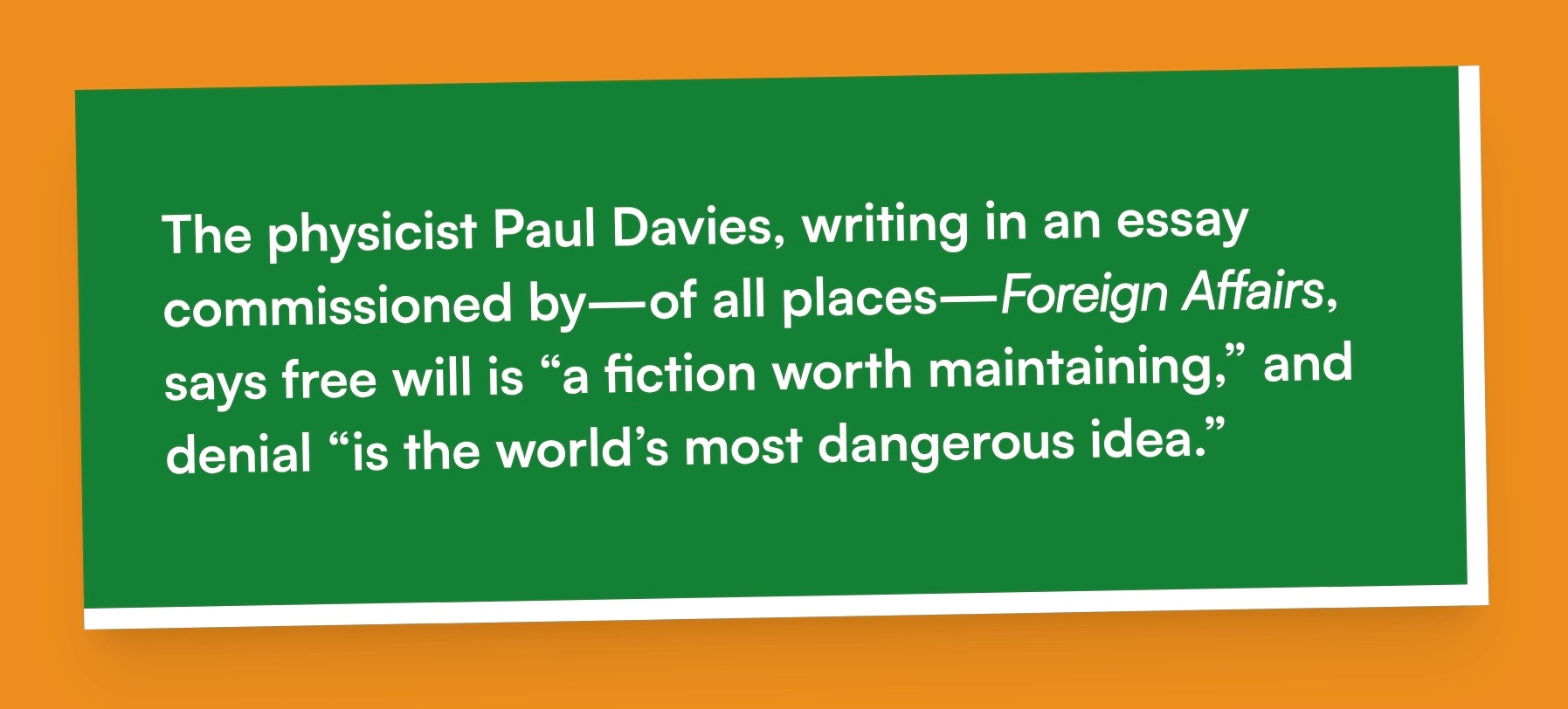
They’re not just trying to justify their grant money with a practical upshot for their research. They categorize the falsity of free will as an “informational existential threat,” like the knowledge of how to build a nuclear bomb or make smallpox into an aerosol. The knowledge that free will is an illusion must be possessed only—the thinking goes—by a small elite who, supposedly, will be strong enough to resist the bad effects. Suppressionists never say nobody should know this truth. How could they, since they know it? I imagine there must be a certain frisson to making an exception for oneself precisely here. The physicist Paul Davies, writing in an essay commissioned by—of all places—Foreign Affairs, says free will is “a fiction worth maintaining,” and denial “is the world’s most dangerous idea.”
It’s not new, this moral panic. Catastrophizing about free-will denial goes way back. But today, it is not mere idle speculation, which it was in 1524, when Erasmus argued for free will against Martin Luther’s denial. Erasmus worried that the common man was too “weak, ignorant, and wicked” to handle what Luther was proposing. Therefore, Luther ought not to say it. But Erasmus did not seriously contemplate Luther’s denial becoming widespread, so his worries were merely abstract pearl-clutching—and self-serving to boot. Erasmus should have felt the bite of intellectual conscience, the pull of a certain epistemological scruple. Because it was in Erasmus’ time—and still should be in ours—a principle recognized by all truth-seekers that one cannot silence one’s interlocutor in a debate by asserting that merely uttering their conclusion would cause harm. It’s akin to ad hominem, as it does not address the issue on its merits (i.e., on the question of whether it’s true or not). Furthermore, it would preclude the discovery of harmful truths; for, indeed, some truths are harmful.
Today’s suppressionism is different because Erasmus believed in free will. These days, recommending suppression is most interesting (and most ethical) when it’s a move made by deniers, i.e., the thinker in Luther’s position. Suppressionist scientists are advocating for the sequestration of their own research. They argue that, if we really and truly believe “the un-free will” (a translation of Luther’s 1525 title) to be dangerous knowledge, then it should be “born classified,” as is the case now for developmental research for new nuclear weaponry. “Perhaps the government could,” I joked with Kelly at the next tea, “in the vein of UFOs, attempt to discredit as a kook anyone who proclaims the dangerous and secret truth that we don’t have free will.”
Thankfully, outright deception may not be necessary. “We are fortunately deceived about free will,” writes Saul Smilansky, professor of philosophy at the University of Haifa, in Israel, and the foremost academic proponent of letting the illusion be. In Plato scholarship, an elite promulgating a falsehood to maintain social order is called a “noble lie.”
A noble lie affirming free will may not be necessary, since few people see their way to the arguments for denial, and most, when the arguments are brought to their attention, do not accept their implications anyway—even when they cannot gainsay the logic. Smilansky worries that graduate students, working under the conviction that free will is false, will become depressed or psychotic post-disillusionment. So he discourages PhD students from working with him. He writes, “We must protect humanity in the hothouse of illusion from the chill of the ultimate perspective.” “I like that,” I remarked to Kelly. “The icy chill of the ultimate perspective.”
Adopting the ultimate perspective without illusions would be to cross one more threshold in the ongoing diminishment of human metaphysical dignity, which includes a familiar list: Copernicus decentering the Earth and us with it; Darwinism making us animal and accidental; Nietzsche and Freud dethroning self-transparent consciousness and foregrounding the unruly unconscious. It’s another instance of borrowed by Joan Didion to describe the ostensibly utopian world of 1968 Haight-Ashbury as, instead, an apocalyptic nightmare. Analogously, free-will denial is seen by some as utopian and by others as catastrophic. The latter think it would cause societal collapse, which must be prevented by a paternalistic noble lie. The former, like Sapolsky and Harris, think the ultimate perspective would yield an egalitarian, socially just, quasi-heavenly sublime, if only we could get people to adopt it. “No one would deserve to be treated any better or any worse than anyone else,” as Sapolsky writes. When I shared that quotation with Kelly at tea, it struck me that denial seems to rhyme with progressive politics. Because, for example, it is the positive belief in free will that allows some people (usually on the political right wing) to blame poverty on the freely made bad decisions of the poor, rather than on structural causes, which, by comparison, play a deterministic role. Also, many of the societal changes that progressives want to see are logical implications of free-will denial, including prison reform and intervention to prevent childhood poverty, to name only those on Sapolsky’s short list.
***
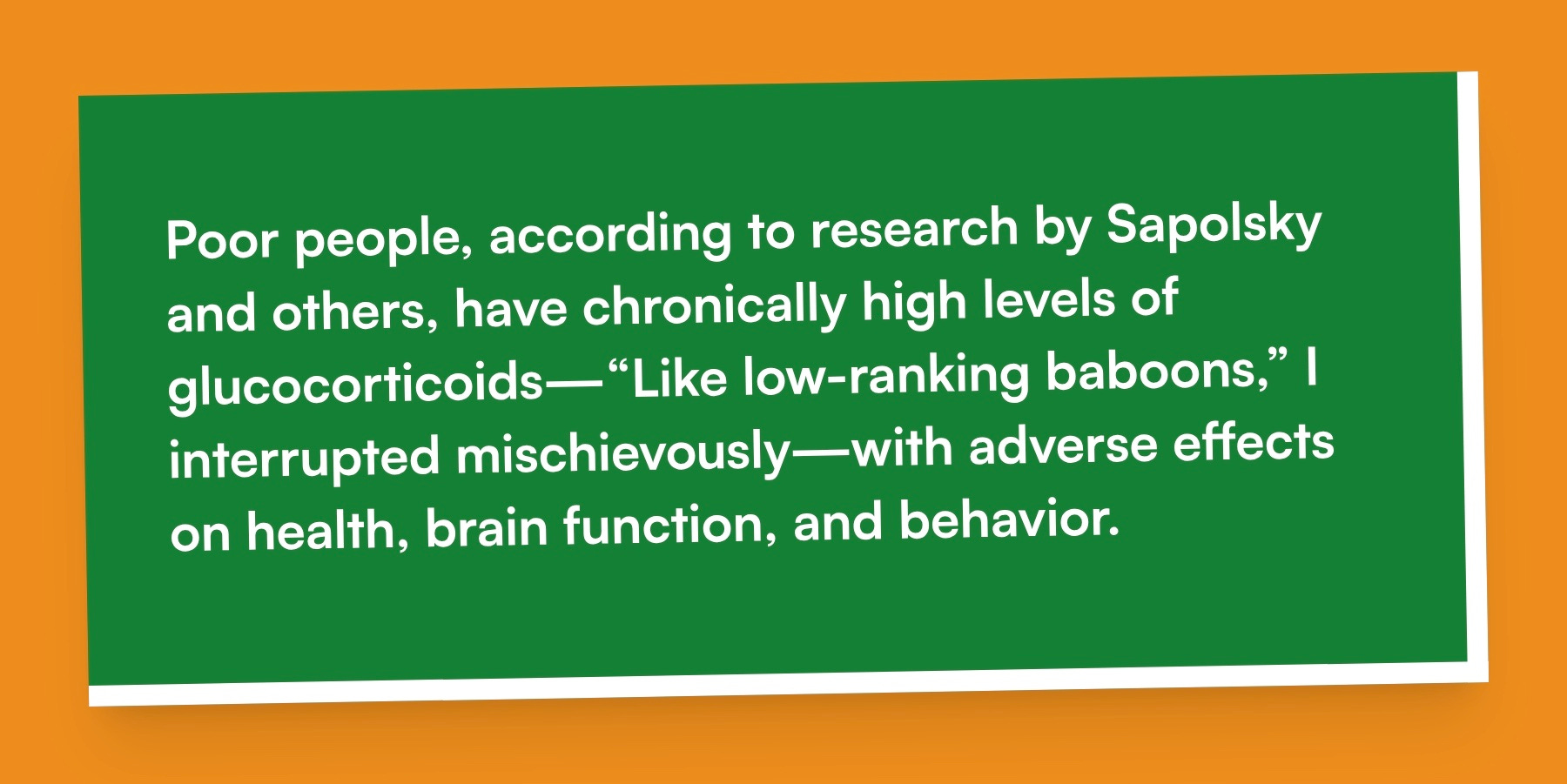
“The progressive-aligned cause Sapolsky is most passionate about in his books,” Kelly replied, “is government intervention to prevent all childhood poverty.” Why? Because it’s unfair what the stress of being poor does to the developing brain. Poor people, according to research by Sapolsky and others, have chronically high levels of glucocorticoids—“Like low-ranking baboons,” I interrupted mischievously—with adverse effects on health, brain function, and behavior. Sapolsky points out that the way stress works in baboons is exactly how stress works in humans. As part of the fight-or-flight system, the stress response is incredibly ancient—it’s shared by all primates and every mammal, bird, fish, and reptile. Same chemical compounds, same interactions.
When triggered, glucocorticoids prepare a creature’s body for emergency action, shutting down systems not essential in emergencies, including digestion, reproduction, neurogenesis, and growth. (I learned there is such a thing as “stress dwarfism”—when growth is markedly stunted by chronic stress in childhood.) In animals less social than baboons and humans, stress hormones are washed away as quickly as they are triggered, as Sapolsky cleverly captured in the title of his 1994 book, Why Zebras Don’t Get Ulcers. By contrast, baboons hunt, gather, and eat all the food they need each day in only a few hours, “leaving the rest of their time to make each other miserable,” Sapolsky writes. The result is chronic stress (only for some, it must be said). In adult humans, the chronic stress of poverty creates a detrimental cognitive load, diminishing the ability to focus attention, according to studies on the psychological effects of poverty. In a 2013 study by researchers at Princeton, rich and poor study participants performed equally well on standard tests of cognition while preoccupied with lab problems involving trivial amounts of money. But if the amounts were $2000, a poor person, on average, displayed a drop in cognitive function analogous to 13 IQ points, or an entire night’s sleep. Rich participants preoccupied by the $2000 scenarios averaged no drop in performance on the cognitive test.
For a child, whose brain is still developing, poverty-caused stress can spell disaster, Sapolsky says. Stress hormones adversely affect the growth of the prefrontal cortex, generating measurable effects like poorer executive function, worse emotional regulation, and deficits in impulse control. Neuroscientist David Eagleman, author of many popular books on the brain, says that poor impulse control makes sense as a factor in criminogenesis. Studies show that prison populations tend to fill out surveys with the correct answers to moral dilemmas—that is, they know right from wrong. But prisoners score below average on tests of impulse control, like the marshmallow test and others. Thereby, nonviolent economic crime, like shoplifting or burglary, would not be caused by lack of economic resources coupled with an upbringing that failed to inculcate prosocial values. It would be caused, instead, by an above-average tendency toward impulsivity, itself caused by factors beyond one’s control.
Sapolsky writes, “The socioeconomic status of a child’s family predicts the size, volume, and gray matter content in the prefrontal cortex. . . in kindergarteners.” Kindergarten is crazy-early to have effects like this show up. But socioeconomic status, i.e., class—human primates’ version of rank among baboons—determines important features of the brain even earlier. The effect is there “in toddlers. In six-month-olds. In four-week-olds. You want to scream at how unfair life can be,” Sapolsky writes. “Actually,” Kelly said, “Sapolsky should be advocating to eradicate poverty not just for all children but for all mothers.” “Oh, yeah,” I said, “you’re right.” For a four-week-old to have a smaller brain, the glucocorticoids must have been present in utero.
***
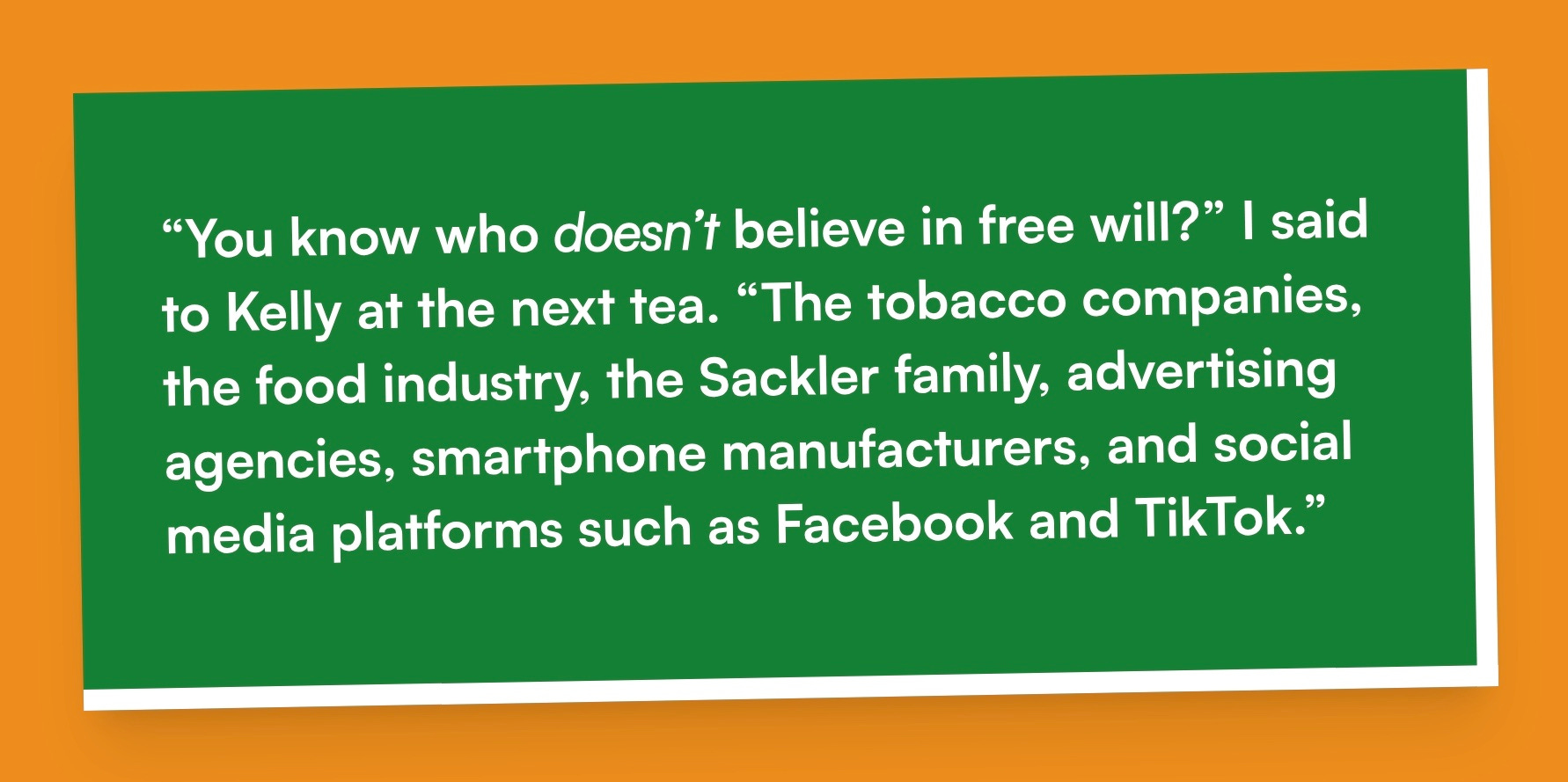
“You know who doesn’t believe in free will?” I said to Kelly at the next tea. “The tobacco companies, the food industry, the Sackler family, advertising agencies, smartphone manufacturers, and social media platforms such as Facebook and TikTok.” Addictive cigarettes and booze; snacks high in sugar, salt and fat; Oxycontin; product placement in movies; the doomscroll: the corporations behind these phenomena know precisely how effective they are in the aggregate with respect to changing the behavior of individuals. The “attention economy,” according to Scott Galloway, celebrity investor, popular podcaster, and marketing professor at New York University, is only a subset of the larger “addiction economy”—made up of companies that have figured out ways to control our behavior by manipulating our dopaminergic reward system. Galloway says—borrowing from E. O. Wilson—we have neolithic instincts, Medieval social institutions, and futuristic, God-like technology, which adroitly pushes our buttons and pulls our strings.
These companies deny free will, at least notionally—i.e., they count on determinism—in their manipulations of our behavior; could denial, instead, help us protect ourselves? Presently, in a culture that believes in free will, resistance to the addiction economy is more difficult than it would be after pervasive denial. Free-will credulity makes it possible to deny disingenuously the phenomena of addiction and manipulation are even happening (“There’s no system of control. People freely choose to eat our unhealthy food product!”) and recommends methods of resistance that might be hopeless (“Just use your willpower!”). Right now, strategies to resist …
To continue reading, please sign up as a free or paid subscriber.
You are not yet subscribed.
“Sleepwalking Towards Bethlehem,” by David J. Frost, first appeared in The Missouri Review, Summer 2026 Issue.
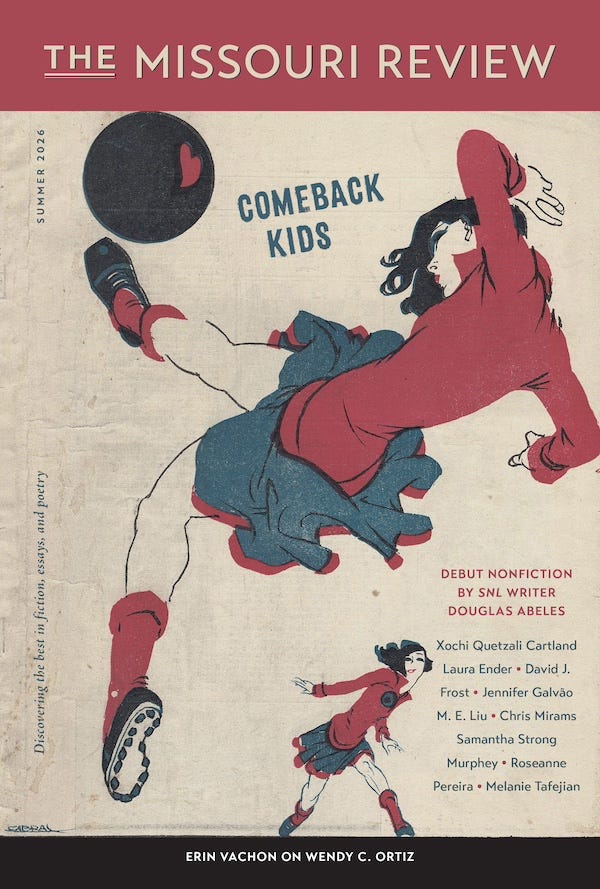
My essay is behind a $24 paywall on the website of The Missouri Review. But paid and free subscribers to my newsletter get complimentary access to a beautifully designed PDF version of my essay.
Please subscribe to download the PDF.
If you are seeing this, you are not yet subscribed. To get my essay, please subscribe. Either free or paid will work. And you can unsubscribe anytime, including immediately. Thank you!
By a strange coincidence, my college roommate pissed on our chest of drawers while sleepwalking once in our dorm room at NYU (something which, decades later, I still gleefully tease him about) AND I am currently reading Sapolsky’s Determined. (I was a convert to no free will before I started.)
Obviously, I haven't read all of this, but ...
To me, this points to people who need meaning and purpose in their lives — who need to be engaged in and contributing something to community/civic life. Doing something productive as opposed to sitting around idly — like baboons.
I’d also love to see a study of people who grew up poor who don’t go on to exhibit a lack of impulse control, like those who end up in jail.
Our psychology and even physiology may predispose us to certain behaviors and actions, but that doesn’t mean we aren’t capable of making the morally right decision in the moment. With more awareness, we can take small steps prior to any questionable action/behavior to condition ourselves to do the right thing when the moment arises.
It seems to me that whether we have free will in those moments doesn’t really matter — because our actions can (and often do) have a positive or negative effect on someone else (as well as on ourselves). Perhaps that consideration should be our North Star.