

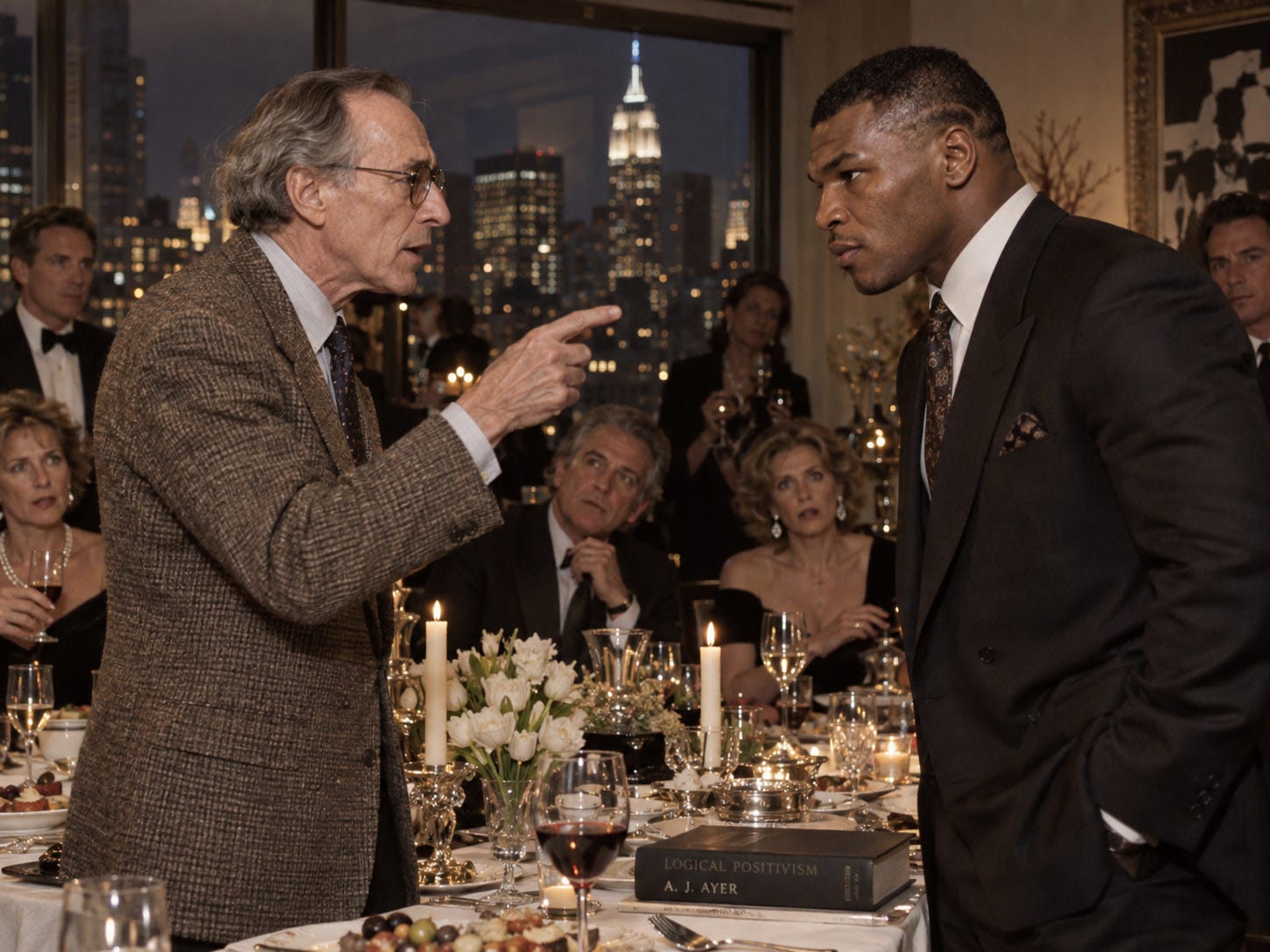
1. In New York in 1987 the Belgian lingerie designer Fernando Sanchez—who had designed Madonna’s outfit for her “Like a Virgin” music video—hosted a lavish dinner party. At one point, sounds of a commotion from the bedroom reached the living room—it was Mike Tyson aggressively flirting with a visibly and auditorily uncomfortable Naomi Campbell.
All of a sudden, a 77-year old, frail looking professor in a tweed jacket stepped between them to intervene. Tyson barked, “Do you know who I am? I’m the boxing heavy weight champion of the world!”
“And do you know who I am?” the professor responded, as Campbell slipped away. “I am the Wykeham Professor of Logic at St. Mary’s College of Winchester in Oxford. We are both pre-eminent in our field. I suggest we talk about this like rational men.”
The professor was A.J. Ayer. His interaction with Tyson was reported in the New York Post’s Page Six society feature.
Ayer’s widely anthologized essay, “Freedom and Necessity,” is assigned in intro to philosophy classes as a cogent example of compatibilism. Ayer asks what the implied definition of free will inherent in libertarianism is. What would it take, by libertarianism’s lights, for an action to be free? Through a kind of reverse engineering, he showa us that libertarianism implicitly holds that to be free, an action must be uncaused. In other words, if to be caused is to be unfree, then to be free is to be uncaused.
But this, Ayer insists, is an erroneous definition of freedom of the will. (A kind of definition Dennett would say is “not worth wanting.”) Instead, while agreeing that all actions are caused, Ayer’s compatibilist definition says that free actions will be those actions caused in the “right way,” by causes that meet certain criteria, for example, my own desire or reasons for my action that I can endorse. What matters is not whether or not my action was caused—everything is caused—what matters is whether the way my action was caused counts as “constraining.” Causes I endorse, like my character or desires I desire to have, make for free unconstrained action, while causes I do not endorse like an addiction-generated desire, which I wish I didn’t have, make for unfree constrained actions.
2. Keeping with our dinner party theme… Paul-Henri Thiry, Baron d’Holbach, a prominent figure in the French Enlightenment period, hosted a salon in Paris from around 1750 to 1780. The group met regularly two times per week, Sundays and Thursdays at d’Holbach’s home, where he entertained his guests with expensive food and wine, amid bookshelves creaking under the weight of his 3000 books. The salon’s regular guests included such notable figures as Denis Diderot, Etienne de Condillac, and Nicolas de Condorcet, and was visited by Jean-Jacques Rousseau, Adam Smith, David Hume, and Benjamin Franklin.
In his work of 1770, The System of Nature, Baron d’ Holbach gives an excellent example of the hard determinist position, which is often anthologized in essay form as, “The Illusion of Free Will.” To illustrate his point, Holbach tells a story about a man lost in the desert who is nearly dying of thirst. This man finally arrives at an oasis town and goes to the fountain in the middle of the town plaza. When he drinks the fountain water because he’s dying of thirst, he seems unfree, Holbach offers. The cause of his drinking is his thirst and Holbach would therefore conclude the man is unfree. But—Holbach writes—a “friend of free will” might offer the following rebuttal: if the man were told beforehand that the water was poisoned, then he would refrain from drinking, which might suggest he refrained freely. That seems to make good sense to many first-year philosophy students.
But Holbach counters this way: the man’s desire for self-preservation caused him to drink when thirsty in the first case, and, in the poisoned case, self-preservation again caused his action, but this time it was to not drink. He is caused either way; therefore, he is unfree.
Hard determinists like Holbach always do the same two-step dance move. All events have causes. Caused actions are unfree. The judgments, or evaluations of the propositions, at each step are supported by strong intuitions. It just does seem true that every event has a cause; and it just does seem true that an action that is caused is unfree because it was necessitated by the cause and effect relations we codify as the “laws of nature.”
For my undergraduates, after our unit on logic, I present two views on free will in terms of two-premise arguments.
The deductive argument for hard determinism:
1) Incompatibility thesis: If determinism is true, then (libertarian) free will is false.
2) Determinism thesis: Causal determinism is true.
Therefore, (libertarian) free will is false.
The deductive argument for libertarianism:
1) Incompatibility thesis: If determinism is true, then (libertarian) free will is false.
2) Causal determinism is not true.
Therefore, free will is not ruled out (at least not for the reason of determinism ruling it out).
If we feel moved to resist the argument for hard determinism, we must acknowledge that the logic is rock solid; it is technically a valid form of argument in propositional logic. The way we can resist it is by arguing that one of the premises is not true. Libertarianism denies the second premise, by denying the universal truth of determinism. Compatibilism denies the first premise, the so-called Incompatibility thesis.
3. Let me back up and start over with how the problem of free will gets going. The philosophical problem of free will is a problem wherein two necessary assumptions appear prima facie to be mutually exclusive. Namely, our pre-theoretical notion that we have freedom of the will and our theory-informed concepts of causation and causal determinism. It will strike some as an oversimplification but here is how I lay out the dialectic and the positions one can take on the problem, that is to say, the various ISMs available in logical space.
On the question of whether free will and determinism are incompatible, two views agree and one dissents. Libertarianism and hard determinism agree that to be free you must be uncaused. Libertarianism says you can be uncaused, hard determinism says you can’t—because hard determinism affirms the truth of “every event has a cause,” and other propositions under the catch-all term of “causal determinism.” For its part, libertarianism denies causal determinism. More to say about both, but the third view is the one that says “No” with respect to the question of free will and determinism’s incompatibility. It says they are compatible. Compatibilism attempts to solve the problem by redefining “free will” away from the definition that got the problem going in the first place. Whether it is legitimate to redefine concepts under dispute in a philosophical debate is a question I will return to.
Libertarianism and hard determinism, thus, share the definition of free will that gets the problem going—libertarianism solves the problem by denying causal determinism, i.e., by saying determinism does not apply to human minds. Hard determinism solves the problem by denying free will via its affirmation of causal determinism, which means we do not have the ability to do what the libertarians think we can do. “Which is what, again?” Kelly asked at tea. Libertarians think that, after we act, it is true that we could have done otherwise, tout court, in the broadest sense of “otherwise.” We could rewind the universe and press play and you could choose something different this time, even without any antecedent conditions changing at all.
4. Without free will, we would lose, “the whole sting and excitement of life,” as the pioneering psychologist William James wrote. We’d lose, he said, “our sense that in it things are really being decided from one moment to another, and that [life] is not the dull rattling off of a chain that was forged innumerable ages ago.”
In law, morality, politics, public policy, religion, and personal relationships our belief in free will seems pivotal. We want our beloved to love us freely, not because of some pheromone-based love potion. According to the philosophical tradition, free will is required for moral responsibility. We praise and blame people for their behavior only on the assumption the given behavior was undertaken, as we say, “of a free will.” If something bad happens beyond your control, you are usually not blamed for it, nor are you praised for a good thing you had nothing to do with.
But for regular people, free will is additionally associated with feeling alive, feeling in charge, feeling like a person. It is difficult to think about oneself in any other way than as an autonomous agent, someone capable of making one decision or another among a range of possibilities. While I cannot successfully will that I jump twenty feet into the air, I can—it would seem—freely will that I jump or that I do not jump.
If the denial of free will were pervasive throughout society, many think the consequences would be disastrous. People sense denialism is destructive somehow of human dignity. It was reported last year in the Guardian that philosopher Galen Strawson received death threats because of his stance against free will. “It seems to provoke some people to an existential crisis,” Strawson said.
Observe your own subtle emotional reactions—please look closely since they may be minute—as I run through the various ways free will has been denied. Some early arguments were theological: God’s divine foreknowledge of what you will do precludes you doing otherwise. Later, after the walloping, world-historical success of Newtonian mechanics, the standard form of denial was called hard determinism. This argument is premised, first, on a deterministic universe—events unfold like in the mechanics of a clock—and, second, on the intuitive judgment that this determinism precludes you doing otherwise than you did.
5. Philosophy often proceeds by showing that something we thought we knew well is actually more mysterious and unfamiliar than we had imagined; that something apparently simple is actually complex; that something we say unthinkingly all the time, does not make sense when subjected to scrutiny.
For this reason, sometimes philosophical problems will not strike the layperson as problems at all. Puzzles based on an apparent contradiction among concepts, like the problem of free will, don’t seem paradoxical if you indulge yourself in the use of fuzzy concepts. The philosopher tells the layperson that if you think harder, you’ll see it’s a problem—you’ll see that the definition of “cause” conflicts with your definition of “free,” for instance. Then, after you’ve seen the problem, the philosopher invites you to think your way to a solution, that is, to think harder still in order to undo the problem that thinking got you into—to find or finesse your way to the proper definitions that unwind the problem. You might be forgiven the temptation to just skip all that thinking—to avoid the whole business by just not thinking about the matter at all.
Philosophers hope against hope that human beings’ occasional discomfort with an internally inconsistent set of beliefs and their sometime aversion to self-delusion will return us to trying to think things through philosophically.
To get us to see what we already believe, a philosopher uses a thought experiment, a tradition going back to Socrates. If philosophers want us to think about what we mean by causation, they might ask us to imagine what caused a plane crash. Imagine everyone is blaming the manufacturer. Imagine the National Transportation Safety Board investigates, including by analyzing the plane’s “black box,” which has recorded the status of all flight systems before, during, and after the crash. The NTSB eventually holds a press conference. The spokesperson announces, “We have conducted a thorough investigation. There was no cause of this crash.” What would we, the press, and the public say? We’d say that’s impossible. There has to be a cause. When we experience events we experience them in connection to what caused them. Upon scrutiny, an event having no cause does not make sense..
Philosophers reconstruct thought experiments like this into the form of logical arguments. The proposition, “It’s impossible for an event to not have a cause,” is an argument for the proposition, “Every event has a cause.”
6. In the past, the case against free will was most often a logical one. It had to do with showing that the proper conception of free will and the proper concept of causation were mutually exclusive. As a thoroughly philosophical problem, many thought it was unlikely to have much impact on how we lived our daily lives. Indeed, many earlier deniers felt compelled to explain how our normal practices of praise and blame could continue on more or less as before denial. Any real contemplation of how society would be affected was hardly ever attempted—in part because deniers attempted to minimize the consequences and in part because hardly anyone believed the arguments. Or rather, even those who believed the logic was valid and the arguments sound, did not really feel the denial. Hardly anyone, even the advocates, felt compelled bodily by the arguments. The deductive arguments against free will might remain the same or change without achieving persuasiveness. Let’s look at the empirical case against free will as it has gone up and down over time—from more strongly supporting skepticism about free will to giving hope to friends of free will.
After the walloping, world-historical success of Newtonian mechanics, the plausibility of free will took a beating.
As the Oxford Handbook on Free Will says that after Newton:
Pierre Simon, Marquis de Laplace, could claim that discoveries in mechanics and astronomy unified by Newton’s theory of gravitation, have made it possible to comprehend in the same analytical expressions the past and future states of the system of the world.... “Given an intelligence which could comprehend all the forces by which nature is animated and the respective situation of the beings who compose it—an intelligence sufficiently vast to submit these data to analysis—it would embrace in the same formula the movements of the greatest bodies of the universe and those of the lightest atom; for it, nothing would be uncertain and the future, as the past, would be present to its eyes,” (Laplace).
Twentieth-century physics threatened this Laplacean or Newtonian determinist vision in several related ways. Quantum theory, according to its usual interpretations, denies that elementary particles composing the “system of the world” have exact positions and momenta that could be simultaneously known by any such intelligence (i.e., Heisenberg’s “uncertainty principle”); and it implies that much of the behavior of elementary particles, from quantum jumps in atoms to radioactive decay, is not precisely predictable and can be explained only by probabilistic, not deterministic, laws.
To be clear:
…the uncertainty and indeterminacy of the quantum world, according to the orthodox view of it, is not merely due to our limitations as knowers but to the nature of the physical world itself.
However, for more than 100 years, philosophers have been going blue in the face attempting to make friends of free will realize that quantum or any other kind of indeterminacy is of no help in securing free will. If there is a spot of randomness between my intention to move my arm and my arm moving (or between any events in the causal chain leading to an action) that does not make the action “free,” it makes it random—more like a twitch than an action, more like blinking than winking. If I intend to move my arm, my leg might kick out instead, if indeterminacy inhered anywhere in the chain. And, if my arm did actually move, it could only be thought of as a fluke.
If you won’t take my word for it, here, again, is the Oxford Handbook on Free Will:
The argument has been made… by prominent twentieth-century scientists (such as Nobel prize-winning physicist A. H. Compton [1935]) that room might be made for free will in nature if undetermined events in the brain were somehow amplified to have large-scale effects on human choice and action. Unfortunately, this modern version of the Epicurean swerve of the atoms seems to be vulnerable to the same criticisms as its ancient counterpart. It seems that such undetermined events in the brain or body would occur spontaneously and would be more of a nuisance—or perhaps a curse, like epilepsy—than an enhancement of an agent’s freedom.
For those among my readers paying attention, this is just the same point I’ve highlighted elsewhere that the libertarian definition of free will is incoherent, or unworkable. It asserts a causa sui, an uncaused causer (or a self-causing cause) which is not possible according to the definition of causation. Why? Because any definition of causation always requires two events, a cause and an effect, occurring at different times, in sequence, or in constant correlation. The attack by free will skeptics against the definition endorsed by libertarian notions of free will is an instance of free will denial funded by deductive arguments a priori which depend on the proper meaning of words and conceptual definitions. And its constitutive concepts are internally incoherent.
Friends of free will—some of them—may wish to abandon the libertarian definition as one we should never have wanted in the first place, since doing without causal determinism is the source of the incoherence of libertarianism; and then they may wish to suggest that a definition of free will “worth wanting” (cf. Dennett) would be one compatible with causal determinism. I will return to questions of whether one can just redefine terms like that in a philosophical debate. And we will need to get clear on what compatibilist theories, like Ayer’s and Dennett’s, say about the problem of free will.
But first let us return to the empirical case against free will, which is importantly different in kind from the a priori arguments. The Oxford Handbook on Free Will again:
While determinism has been in retreat in the physical sciences [note: this alludes to quantum mechanics], developments in other sciences—biology, neuroscience, psychology, psychiatry, social and behavior sciences—have been moving in the opposite direction. They have convinced many persons that more of our behavior is determined by causes unknown to us and beyond our control than previously believed. These scientific developments include a greatly enhanced knowledge of the influence of genetics and heredity upon human behavior; a rapidly growing body of research on the functioning of the brain in the neurosciences; a greater awareness of biochemical influences on the brain; the susceptibility of human moods and behavior to drugs; the advent of psychoanalysis and other theories of unconscious motivation; the development of computers and intelligent machines that mimic aspects of human cognition in deterministic ways; comparative studies of animal and human behavior that suggest that much of our motivational and behavioral repertoire is a product of our evolutionary history; and the influences of psychological, social, and cultural conditioning upon upbringing and subsequent behavior.
The empirical case proceeds apace. Oh, I like that it rhymes.
7. Might there be room for additional contemplation about the origins of the problem? Perhaps in a way that would help us untangle it?
As I already said the problem of free will is the philosophical challenge of reconciling mutually inconsistent concepts—so it’s a conflict between various ways we have of understanding the world. According to Joshua Greene, the Princeton philosophy and psychology professor, the conceptual tension actually has deeper psychological—even physiological—origins in a conflict among some of our most basic cognitive mechanisms. According to Greene, there is a conflict between our cognitive module for thinking about objects and our cognitive module for thinking about other consciousnesses, subjects of experience like ourselves—“folk physics” and “folk psychology,” respectively.
Greene asks us to imagine the point of view of our evolutionary ancestors, a scientifically naïve proto-caveman. “Looking out at the world, it appears to contain two fundamentally different kinds of entities. On the one hand, there are ordinary objects… things like rocks and puddles of water and blocks of wood. These things do not get up and move around on their own. They are, in a word, inanimate.” They do, however, exhibit a sort of regularity for which we could draft some proto laws of nature. Rocks thrown up, come back down. A feather falls more slowly than a rock, etc. “On the other hand, there are things that seem to operate by some kind of magic. Humans and other animals, as long as they are alive, can move about at will,” and in apparent defiance of any regularity they might have exhibited before. People can be unpredictable. “It makes sense, from an evolutionary perspective, that creatures [like us] would evolve separate cognitive systems for processing information about each of these classes of objects.”
Greene references a line of research beginning with social psychologist Fritz Heider that undergirds this point about our distinct cognitive modules. In the 1940s, “Heider created a film involving simple geometric shapes that move about in various ways. For example, a big triangle chases a little circle around the screen, bumping into it. The little circle repeatedly moves away, and a little triangle repeatedly moves in between the circle and the big triangle.” When normally functioning people watch this film, they cannot help but view it in social terms. People “see the big triangle as trying to harm the little circle, and the little triangle as trying to protect the little circle; and they see the little triangle as afraid and the big triangle as frustrated.” We see animate creatures acting on the basis of beliefs, intentions, and desires. “Some even spontaneously report that the big triangle is a bully.”
Viewers of the film who have damage to the amygdala—a subcortical brain structure that is important for social cognition—make no such attribution of mental states to the geometric shapes.
Greene says the fundamental difference between the two modular cognitive systems turns on causation. Folk psychology posits an uncaused causer and folk physics assumes regular patterns and predictable causal chains. [As for folk physics, studies have shown that people affirm “that a ball shot out of a curved tube resting on a flat surface will continue to follow a curved path,” when in fact it will follow a straight path. The fact that “people’s physical intuitions are slightly, but systematically, out of step with reality suggests that the mind brings a fair amount of implicit theory to the perception of physical objects.”]
“One can see,” Greene writes, “how the problem of attributive free will arises. To see something as a responsible moral agent, one must first see it as having a mind. But, intuitively, a mind is, among other things, an uncaused causer. Consequently, when something is seen as a mere physical entity operating in accordance with deterministic physical laws, it ceases to be seen, intuitively, as a mind.”
For me it has been helpful to remember some scenes from the film Ex-Machina. In an elaborate Turing test, a visitor is tasked with determining whether it is appropriate to attribute consciousness to an artificial humanoid. The visitor falls in love with the robot. Meanwhile, the manufacturer of the robot, played by Oscar Issac, is nightmarishly abusive to his creation. The visitor, not knowing how the “person” in front of him works, treats it according to the cognitive module for persons; whereas the inventor, who ostensibly knows how the robot is merely a creation, treats it with his cognitive module for inanimate things.
Back to Greene… After eons of thinking of one another as uncaused causers, “science comes along and tells us that there is no such thing—that all causes, with the possible exception of the Big Bang, are caused causes (determinism). This creates a problem,” Greene writes. When we look at people as physical systems, “we cannot see them as any more blameworthy or praiseworthy than bricks,” or a rainstorm when we are picnicking. But when we perceive people (and even objects) using our intuitive, folk psychology, “we cannot avoid attributing moral blame and praise.”
Greene’s idea about a conflict between cognitive modules explains denier Robert Sapolsky’s slogan that “Free will is just the biology we don’t know about yet.” Indeed, the salience and availability of a causal explanation for a particular human behavior is inversely proportional to the intuition that the behavior was enacted by a free will. The more explained, the less free. Which, again, makes sense in light of Greene’s hypothesis about humans having two different explanation-providing modules, one for objects, one for minded creatures. A mind almost by definition is an uncaused causer, a consciousness capable of spontaneous, free activity. This is why the Turing test is dispositive. If you don’t know it’s a bucket of bolts but it seems like a minded, intelligent creature to you, then it makes sense to say that it is one, since we are all buckets of bolts and we have minds.
Greene’s idea also stands behind the Turing Test’s dispositive usefulness. If you don’t know it’s a bucket of bolts and it seems to you like a minded, intelligent agent, then it makes sense to say it is one. And conversely, when we’ve taken something as minded and then we learn about the mechanisms that produced its behavior, we cease to see it as a mind. Indeed, in a prisoner’s dilemma game, a player will incur a cost to punish another player for “defecting” too many times in a row. But when they learn the other player is a robot, they do elect not to incur that cost to punish.
The End
(for now)
Note: Let me end these fragmentary sections here for this week. I will follow up in the weeks ahead with more “Behind the Scenes”—sections about:
the mind-reading experiments of Benjamin Libet and Libet versions 2.0 and 3.0 more recently in the labs of Soon, Haynes, and Huth;
fatalism versus hard determinism;
how Sam Harris can account for “voluntary action” when both voluntary and involuntary actions would be unfree on his hard determinist account;
my take on the book reviews of Sapolsky’s Determined in The New Yorker (by Nikhil Krishnan) and in the Guardian (by Oliver Burkeman);
my umpiring, refereeing, and scorekeeping with respect to the dispute between Harris and Dennett over Harris’s book Free Will and Dennett’s nasty review of it;
the two definitions of “free will” (the libertarian and the compatibilist definitions) and the confusion they created between Dennett and Harris because they were (mostly Dennett was) unclear when switching from one usage to the other;
Dennett’s claim that Harris’s denial of “free will” would mean “people could stop paying their mortgages.” Which is one instance of Dennett’s refusal to translate his comments into Harris’s idiom—an idiom wherein Harris denies “free will” only in the libertarian sense, which, after all, Dennett does too. And Dennett, ostensibly, does not think his own view means people could stop paying their mortgages.
Is this all merely arguing semantics? No. I will show why there is nothing “merely” about it when philosophers argue semantics.
What do the folk actually believe? The experimental philosophy movement and studies from psychology departments have tried to limn the contours of the folk concept. Are the folk naturally incompatibilist?
Methodological considerations: why does it matter what the folk think?
Really enjoyed this. The point about indeterminacy seems especially important: randomness can't rescue free will. If my action is completely caused, I didn't ultimately author those causes; if some element is random, I didn't author the randomness either.
Beautiful. I enjoyed this.
For one, it matters what the folk think because the folk vote. And the majority of voters are “folk.” The light be winnable though, and shown the pure obscenity of holding people morally blame and praiseworthy.
We just don’t like each other. That’s real, and a problem. Moral blame and praise is an aesthetic judgment masquerading as an ethical one.